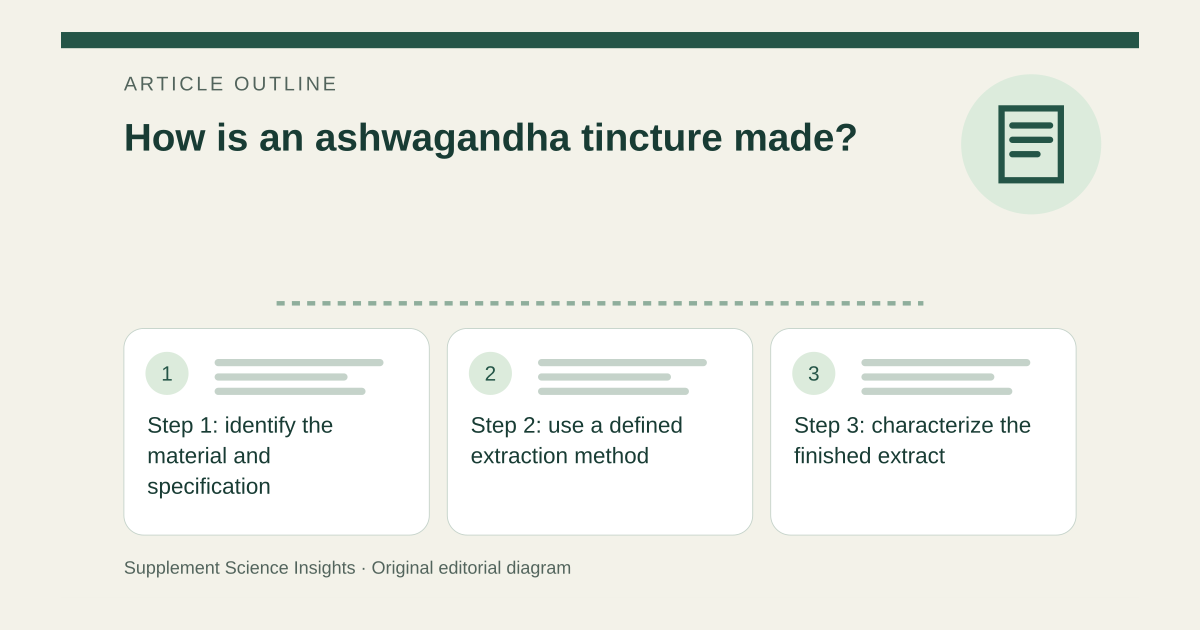
Step 1: identify the material and specification
Confirm the botanical identity, plant part and material quality before extraction. Root and leaf are not automatically interchangeable. A reproducible preparation also specifies the amount of starting material, solvent composition and intended final extract; a jar filled by eye does not establish a dose. [1][2]
Step 2: use a defined extraction method
Maceration means soaking the material in the selected solvent; percolation passes solvent through it. The extraction conditions, including solvent, temperature and duration, influence which constituents enter the liquid. A generic tincture ratio is not a validated ashwagandha processing protocol. [1]
Step 3: characterize the finished extract
The finished preparation needs identity, composition, purity and contaminant specifications, with appropriate analysis. A plant-to-extract ratio records a manufacturing relationship; it does not prove the concentration of active constituents or equivalence to a clinical-trial capsule. The sources reviewed here do not establish a home filtration, storage or shelf-life standard. [1]
Step 4: do not invent a dosing conversion
Imagine a homemade bottle is labeled 1:5. That ratio alone cannot tell you how many drops equal a standardized extract used in research. Seek a properly characterized preparation and qualified advice if considering use; the usual ashwagandha contraindications still apply. [1][3]
| Stage | Required information |
|---|---|
| Starting material | Identity and plant part |
| Extraction | Solvent and controlled conditions |
| Finished liquid | Composition and quality testing |
| Dose and storage | Validated product-specific information |
Sources for this article
- Understanding plant to extract ratios in botanical extracts - PMC
Source consulted: 2026-09-21. This is a reference resource, not a claim that we conducted the studies or tested a product. - Ashwagandha: Is it helpful for stress, anxiety, or sleep? - Health Professional Fact Sheet
Source consulted: 2026-09-21. This is a reference resource, not a claim that we conducted the studies or tested a product. - Ashwagandha: Usefulness and Safety | NCCIH
Source consulted: 2026-09-21. This is a reference resource, not a claim that we conducted the studies or tested a product.