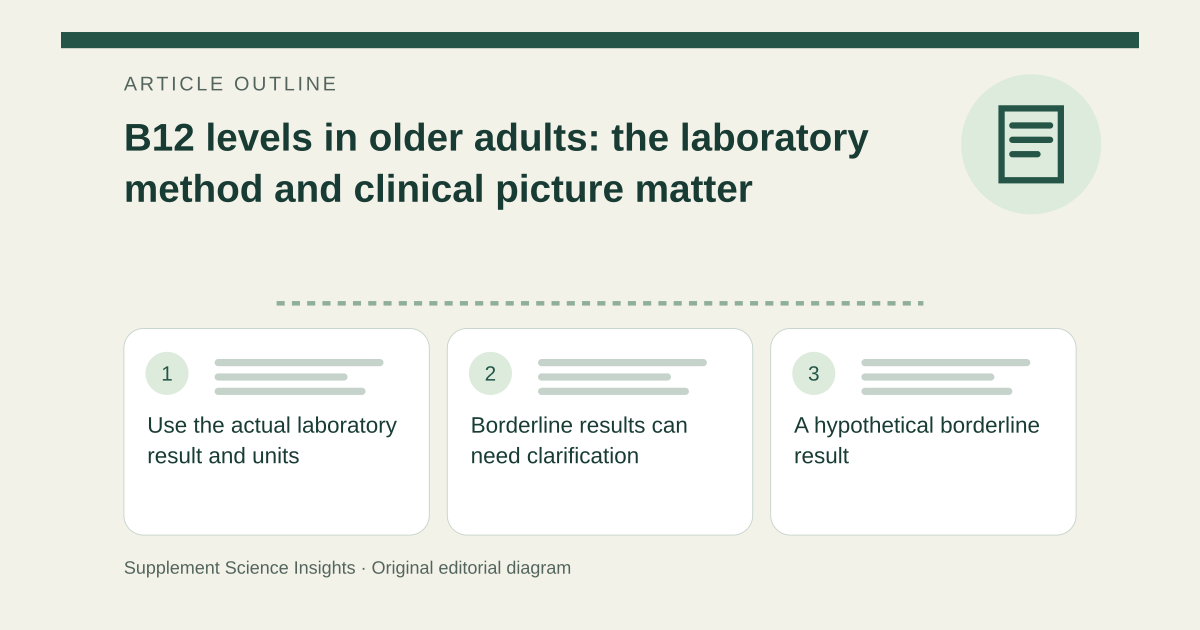
Use the actual laboratory result and units
NIH ODS reports that laboratories commonly consider serum B 12 below 200 or 250 pg/mL subnormal, with the cutoff varying by method. A result should therefore be read with its own reference range. These figures are not a separate elderly target, and a higher value is not automatically a better treatment outcome. [1]
Borderline results can need clarification
ODS describes checking methylmalonic acid when B 12 is 150–399 pg/mL to help clarify possible deficiency. MMA can also rise with kidney impairment and tends to be higher in older adults, so it is not a standalone diagnosis. Symptoms, diet, medicines, previous supplementation and medical history remain important. [1]
A hypothetical borderline result
Imagine an older adult has B 12 of 250 pg/mL and new numbness. Labeling the number normal without reviewing the laboratory range and symptoms would be incomplete. Conversely, the same number cannot identify a cause or prescribe injections by itself. Record units and existing B 12 use and discuss further assessment. [1]
| Hypothetical information | Why it matters |
|---|---|
| B 12=250 pg/mL | Interpret with laboratory range |
| New numbness | Clinical assessment remains necessary |
| Reduced kidney function | Can affect MMA interpretation |
Sources for this article
- Vitamin B12 - Health Professional Fact Sheet
Source consulted: 2026-09-20. This is a reference resource, not a claim that we conducted the studies or tested a product.