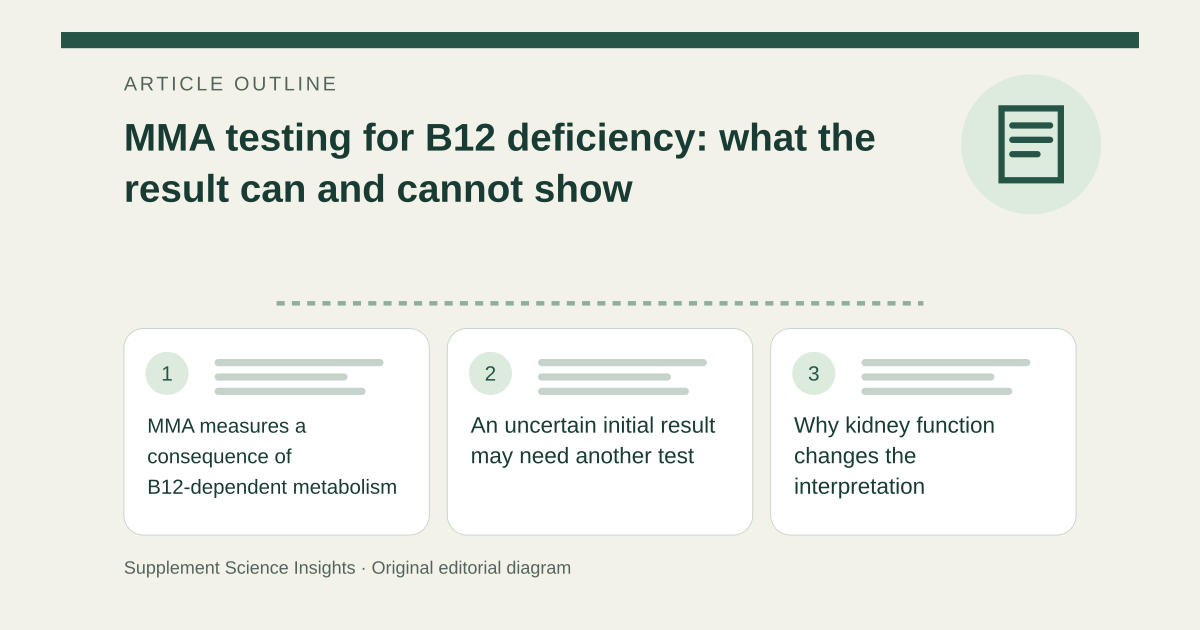
MMA measures a consequence of B12-dependent metabolism
Methylmalonic acid, usually shortened to MMA, is a metabolite that can rise when B12-dependent metabolism is impaired. It is a different measurement from total B12 in the blood. A clinician may use it to investigate possible deficiency when the initial B12 result and the symptoms do not give a clear answer. [1]
NIH ODS describes MMA as a sensitive marker of B12 status. Sensitivity is useful, but it does not mean an elevated MMA value has only one possible explanation. Kidney function and age also influence the result. [1]
An uncertain initial result may need another test
NICE recommends total or active B12 as the initial test in most people aged over 16 with suspected deficiency, with different initial-testing advice for pregnancy and suspected nitrous oxide-related deficiency. Its further-testing pathway uses MMA in selected people with symptoms or signs and an indeterminate initial result. [2]
The test is therefore part of a clinical sequence, rather than an automatic extra test for every person. The laboratory’s reference range, the original B12 result, symptoms and risk factors need to be read together. A threshold copied from a different laboratory or guideline can create false precision. [2]
Why kidney function changes the interpretation
ODS notes that MMA can increase with renal insufficiency and tends to be higher in older adults. An elevated value in someone with impaired kidney function does not independently prove that inadequate B12 intake is the cause. The clinician may need additional information to separate possible explanations. [1]
Homocysteine is another metabolic marker, but it is also influenced by factors other than B12, including folate status and kidney function. Substituting one isolated number for another does not eliminate the need for clinical interpretation. [1]
Two similar numbers can require different reasoning
Consider two hypothetical reports flagged for raised MMA. One belongs to a person with a borderline B12 result and new sensory symptoms; the other belongs to someone with reduced kidney function. The shared flag is a prompt to interpret the findings, not proof that both people need an identical B12 regimen.
Keep the test name, value, unit, laboratory range and date together. If there are previous results, compare the same measurement in compatible units rather than comparing an MMA concentration directly with the micrograms printed on a supplement bottle.
| Report context | Interpretation limit |
|---|---|
| Raised MMA with indeterminate B12 | May support further deficiency assessment |
| Raised MMA with reduced kidney function | Kidney-related elevation must be considered |
| B12 products used before sampling | Record the preparation and timing |
Tell the clinician about supplements before testing
NICE advises obtaining diagnostic samples before replacement is started where feasible and asking about B12 products already used. Supplementation can raise total or active B12 without necessarily fully treating deficiency. Do not conceal prior doses or invent a washout interval. [2]
Testing should not create a harmful delay. NICE specifically advises clinicians not to delay replacement while awaiting results in suspected megaloblastic anemia with neurological symptoms. This is a clinical decision, not an instruction to order MMA or self-treat based on an online cutoff. [2]
Sources for this article
- NIH ODS — Vitamin B12: Health Professional Fact Sheet
Source consulted: 2026-09-17. This is a reference resource, not a claim that we conducted the studies or tested a product. - NICE NG239 — Vitamin B12 deficiency in over 16s: recommendations
Source consulted: 2026-09-17. This is a reference resource, not a claim that we conducted the studies or tested a product.