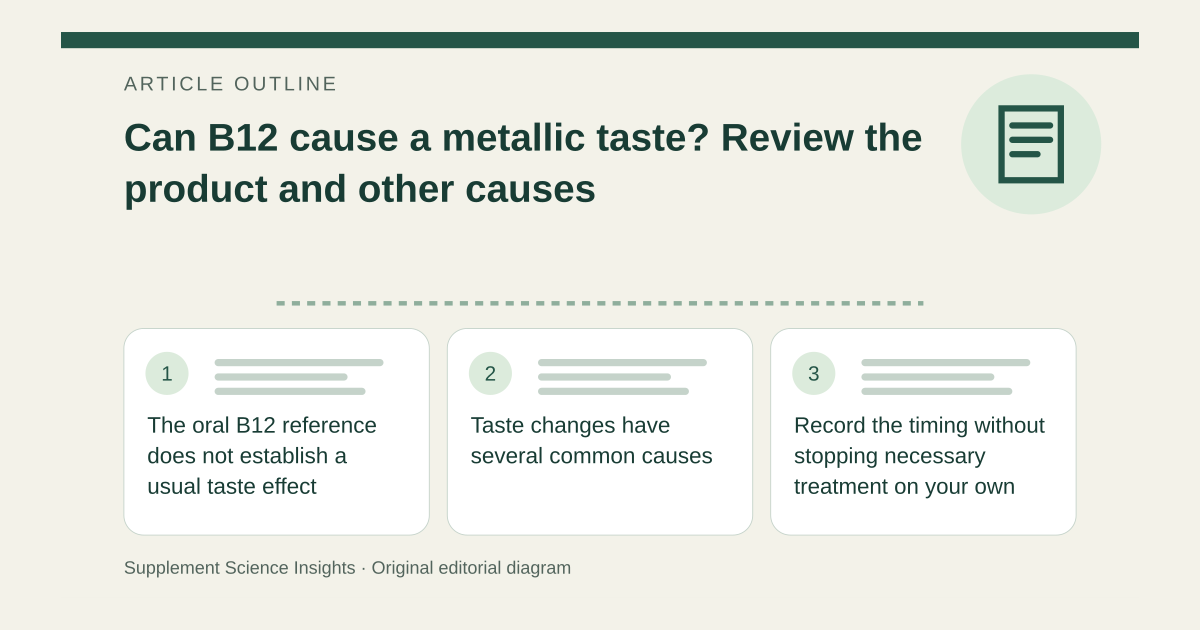
The oral B12 reference does not establish a usual taste effect
NHS says most people have no side effects from cyanocobalamin tablets and highlights cobalt sensitivity and rare allergic reactions. Its list is not exhaustive. It does not establish persistent metallic taste as an expected effect for all B12 forms or products. [1]
Taste changes have several common causes
NHS lists gum disease, some medicines, respiratory infections, indigestion and pregnancy as possible explanations. A new taste is therefore not a reliable sign of B12 toxicity or a reason to assume a deficiency. The full product and medication list are useful to a pharmacist. [2]
Record the timing without stopping necessary treatment on your own
Imagine the taste began after a flavored B12 tablet was added. Record the preparation, dose and timing, and discuss persistent or unexplained symptoms with a clinician or dentist. Do not abandon prescribed deficiency treatment without a replacement plan. Swelling or breathing difficulty needs emergency help, not a taste investigation. [1][2]
| Observation | Appropriate distinction |
|---|---|
| New taste after a tablet | A temporal association |
| Persistent metallic taste | Review oral health and medicines |
| Swelling or breathing difficulty | Emergency allergy symptoms |
Sources for this article
- Side effects of cyanocobalamin - NHS
Source consulted: 2026-09-20. This is a reference resource, not a claim that we conducted the studies or tested a product. - Metallic taste - NHS
Source consulted: 2026-09-20. This is a reference resource, not a claim that we conducted the studies or tested a product.