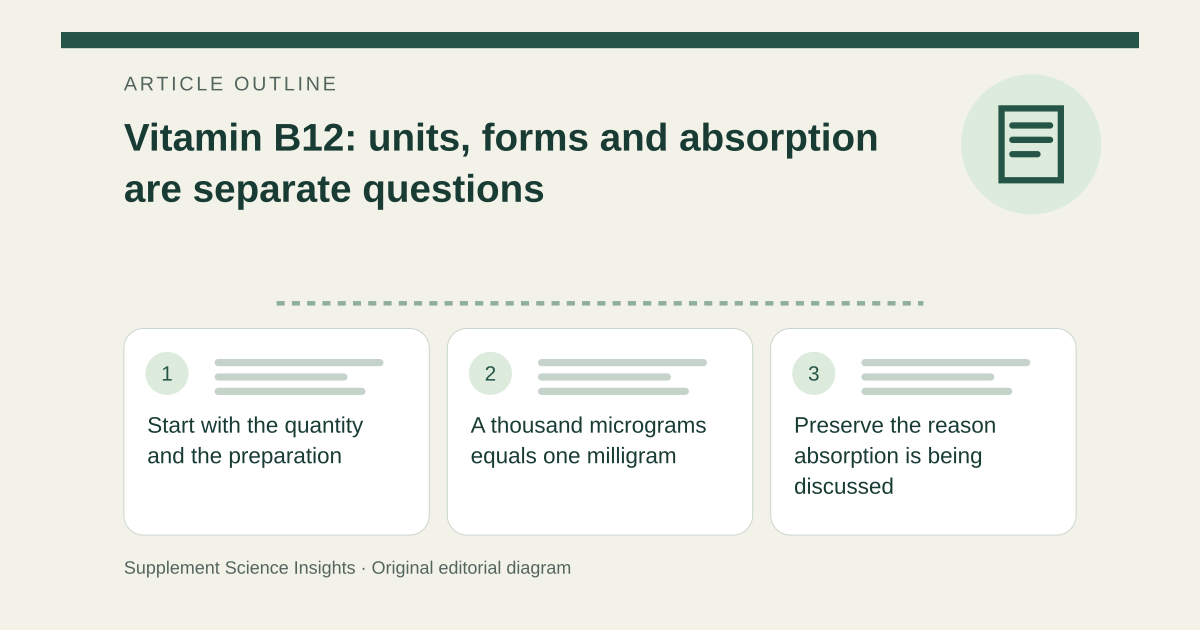
Start with the quantity and the preparation
Vitamin B12 supplements use several forms, including cyanocobalamin and methylcobalamin. NIH ODS reports no evidence that supplement absorption rates differ by B12 form. A form name alone therefore does not establish an absorption advantage. [1]
For a comparison record, copy the full form name, declared quantity, unit and serving definition. Keep the route and directions visible as well. Avoid replacing these details with a broad marketing category such as “active” or “premium.” [1]
A thousand micrograms equals one milligram
An invented label declares 1,000 micrograms of B12 per serving. Because 1 mg equals 1,000 micrograms, the same labeled amount can be written as 1 mg. It is not 1,000 mg. Changing the unit changes the written number, not the quantity.
The example is a unit conversion, not a recommended intake. It does not say that the entire labeled amount reaches the bloodstream. Keep “amount supplied” and “amount absorbed” in separate columns; the second cannot be filled in from this label alone.
| Entry | Meaning |
|---|---|
| 1,000 micrograms | Same mass as 1 mg |
| 1 mg | Not 1,000 mg |
| Amount absorbed | Not established by label quantity |
| Recommended intake | Not supplied by this example |
Preserve the reason absorption is being discussed
ODS describes several steps involved in B12 absorption and notes that the fraction absorbed falls at higher supplemental amounts. Difficulty releasing food-bound B12 and lack of intrinsic factor are different clinical circumstances. [1]
When reading a claim, identify which circumstance the supporting evidence addresses. Do not assume that an observation in one population applies to everyone, or use the printed quantity to calculate an individual’s absorbed amount. This worksheet does not choose a route of treatment. [1]
Symptoms require assessment, not a label-based diagnosis
B12 deficiency can cause neurological changes even without anemia. Metformin and some acid-suppressing medicines can affect B12 status. Discuss symptoms and the complete medicine history with a clinician; do not stop prescribed medicine on the basis of a supplement page. [1]
Prepare focused questions: what finding needs explanation, what further assessment is appropriate and how would a proposed intervention be monitored? Fatigue or a large Daily Value percentage on a bottle does not answer those questions. [1]
Keep unlike measurements out of the same comparison
A blood test concentration and a supplement quantity have different denominators and purposes. Record each in its original units with the date and source. Do not place the two numbers in a strength ranking or treat them as directly convertible.
Similarly, document any energy or cognition claim separately from the ingredient amount. Ask which patient-relevant outcome was measured and in whom. A product description is not a substitute for examining that evidence.
Use the calculation for the question it answers
The fictional conversion establishes that 1,000 micrograms and 1 mg express the same mass. It does not establish deficiency, treatment success, suitability of a formulation or a benefit from taking more.
The source below is a government synthesis, not an independent head-to-head test of retail products. This introductory page makes no efficacy ranking or treatment protocol; scientific and editorial review remains pending.
Sources for this article
- NIH ODS — Vitamin B12: Health Professional Fact Sheet
Source consulted: 2026-09-17. This is a reference resource, not a claim that we conducted the studies or tested a product.
Considering a supplement?
Ingredient evidence alone does not establish which retail product is suitable. The featured option illustrates the label and formulation context above; it is not a clinical efficacy ranking.
Compare vitamin b12 formulations (retail checks pending) → No overall winner
Compare formulations → · How we select products