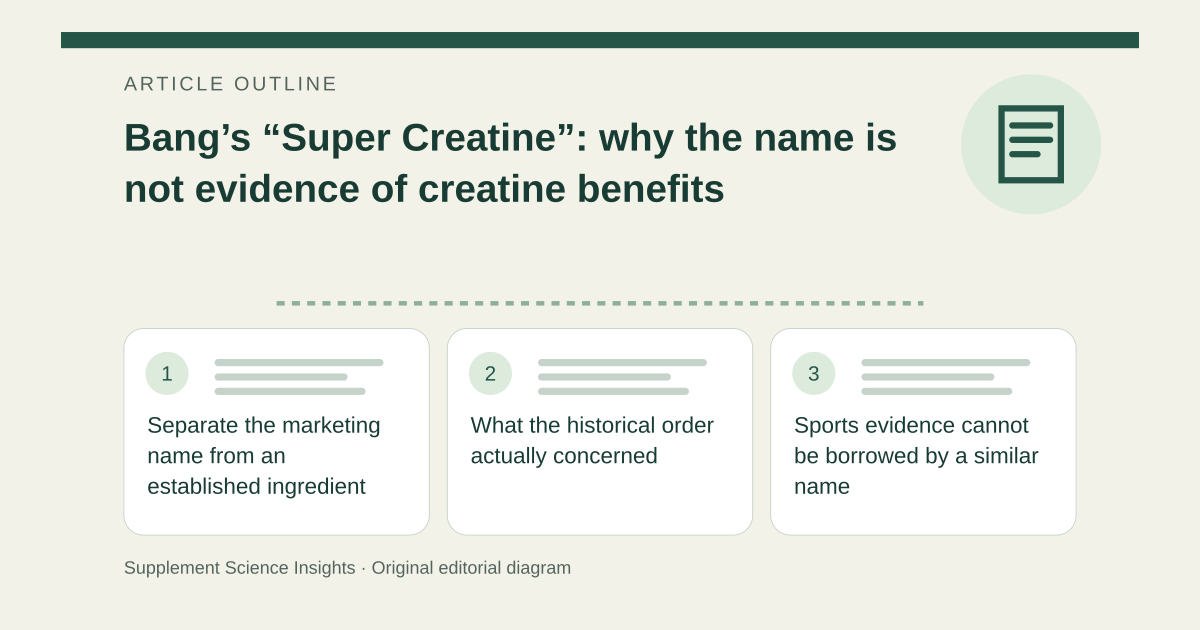
Separate the marketing name from an established ingredient
The district-court record addresses “Super Creatine,” creatyl-L-leucine and claims that Bang provided creatine or its benefits. A name containing creatine is not sufficient evidence of chemical identity, bioavailability, dose or clinical equivalence to creatine monohydrate. [1][2]
What the historical order actually concerned
An April 12, 2023 order in Monster Energy Company v. Vital Pharmaceuticals and John Owoc barred the defendants from falsely or deceptively marketing the specified drinks and ingredient claims as containing creatine or providing its benefits. This is a district-court order reproduced in an appendix hosted on the Supreme Court’s docket site; it is not a Supreme Court scientific finding. [1]
Sports evidence cannot be borrowed by a similar name
NIH’s discussion of creatine performance benefits concerns identified supplementation protocols and forms, principally monohydrate. It does not establish that a differently named ingredient in an energy drink delivers the same exposure or outcome. A persuasive comparison would require evidence for that actual ingredient and dose. [2]
An old label does not establish today’s formula
The historical litigation record is not a current ingredient inventory for every Bang flavor or market. Read the package presently being considered. Do not infer a modern formula, creatine content or absence of caffeine from an old advertisement or this historical order. [1][2]
Ask for identity and evidence together
Imagine a can image from an old post is used to promise the muscle benefits of several grams of monohydrate. The image cannot establish that equivalence. Confirm the actual current label, ingredient identity and relevant research before treating it as a creatine source. [1][2]
| Claim element | Evidence needed |
|---|---|
| Similar ingredient name | Actual chemical identity |
| Creatine-like benefit | Research on that formulation |
| Equivalent serving | Verified amount and exposure |
| Old can image | Not current formula confirmation |
Sources for this article
- Monster Energy v Vital Pharmaceuticals - district-court orders reproduced in petition appendix
Source consulted: 2026-09-21. This is a reference resource, not a claim that we conducted the studies or tested a product. - Dietary Supplements for Exercise and Athletic Performance - Health Professional Fact Sheet
Source consulted: 2026-09-21. This is a reference resource, not a claim that we conducted the studies or tested a product.