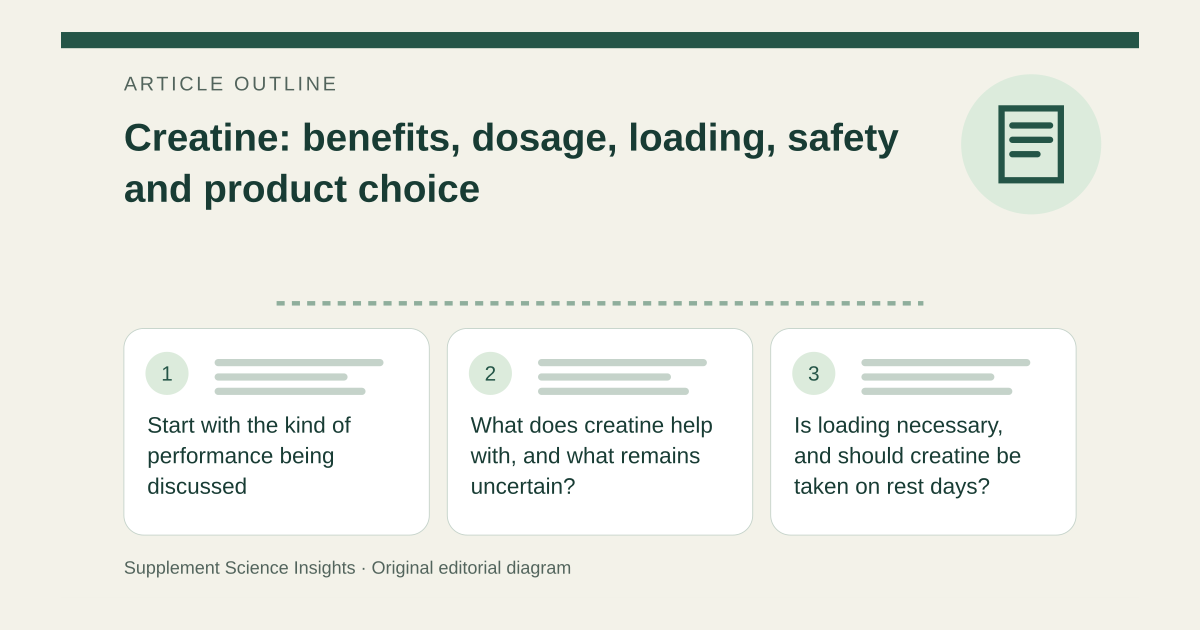
Start with the kind of performance being discussed
Creatine helps supply energy for brief, intense muscular activity. The NIH ODS synthesis describes evidence most relevant to repeated high-intensity efforts; that context is different from a promise to improve every sport or every measure of fitness. [1]
A useful first question is “What task was measured?” Repeated sprints, a strength test, distance performance and an everyday feeling of energy are different outcomes. A claim becomes broader when those differences disappear from its wording. [1]
What does creatine help with, and what remains uncertain?
The clearest performance case is creatine monohydrate alongside repeated high-intensity exercise and resistance training. It is not an anabolic steroid, and it does not replace progressive training. Endurance performance, everyday energy and cognitive function are separate outcomes with different evidence. [1][3]
For women and older adults, keep the training program and measured outcome visible. Research in older women has found benefits for muscle outcomes when creatine was paired with resistance training, without establishing the same benefit for bone mass. Evidence in one life stage does not establish safety during pregnancy or breastfeeding. [1][3]
Is loading necessary, and should creatine be taken on rest days?
A common research protocol uses about 20 g/day, divided into smaller doses, for 5–7 days, followed by 3–5 g/day. Loading is optional: smaller daily amounts can raise muscle stores more gradually. The loading phase changes the speed of saturation rather than making the supplement necessary or proving a larger final benefit. [1][2]
Creatine is used to maintain tissue stores, so daily-use protocols include rest days. These protocols do not establish a mandatory pre-workout minute or a need to cycle on and off. A dose used in healthy adults should not be transferred automatically to a child, pregnancy or someone with kidney disease. [1][2]
Water weight and creatinine are not interchangeable with harm
An early increase on the scale can reflect water retained with increased muscle creatine stores. It is not automatically fat gain or newly built muscle. Gastrointestinal tolerance can differ, particularly with larger single servings. [2]
Creatine can also affect serum creatinine, a marker used in kidney assessment. A changed laboratory number should be interpreted with supplement use, medical history and other tests; neither “it is just creatine” nor “it proves kidney damage” is a reliable diagnosis. Tell the clinician what you take before interpreting a result. [2]
What about hair loss and brain benefits?
A 2025 randomized trial directly assessed hair outcomes in resistance-trained men taking 5 g/day for 12 weeks. Among 38 completers, it found no significant between-group pattern of change in DHT or measured hair outcomes. This is more direct evidence than inferring hair loss from a hormone result alone, but it cannot establish effects over years or in every population. [4]
Cognitive studies should remain separate from the training evidence. A result during sleep deprivation, in a selected age group or on one task does not establish a universal focus benefit or a routine high-dose cognitive regimen. The detailed cognition pages below identify the specific study setting. [4]
How to compare powder, capsules, gummies and branded ingredients
Start with the declared creatine monohydrate amount, serving units and complete ingredient list. Compare price per declared gram, not container size or scoop count. Capsules or gummies may be convenient, but their unit count and extra ingredients can change the cost of the same labeled amount. [1]
A raw-material trademark, micronized texture or greater solubility does not by itself prove superior strength gains. Verify any quality certification for the exact finished product. A trademarked ingredient and a batch test answer different questions, and neither guarantees that a person will respond. [1]
Keep the exact form attached to the evidence
Creatine monohydrate is the most extensively studied form discussed by ODS. The resource does not establish general superiority for more expensive alternative forms. A new name, a solubility claim or an altered texture is not itself evidence of a better training outcome. [1]
When comparing a paper with a label, transcribe the complete preparation name. If the product is a mixture, keep the other constituents visible. A trial of a single preparation cannot automatically explain the effect of a multi-ingredient blend. [1]
A blend total is not the creatine amount
An invented “performance blend” weighs 6 g per serving and lists creatine with two other ingredients. Without separate amounts, the label does not establish how much of the 6 g is creatine. Equal division into three 2 g portions would be an assumption.
Contrast that with a fictional label declaring its creatine monohydrate quantity separately. The second label answers the quantity question more directly; it still does not establish efficacy, purity or personal suitability. No example here sets an intake target.
| Label statement | What can be recorded | What remains unknown |
|---|---|---|
| Three-ingredient blend: 6 g | Total blend mass per serving | Individual creatine amount |
| Creatine listed by name | Presence is declared | Actual batch identity or purity |
| Performance claim | Claim wording can be copied into notes | Whether the exact preparation supports it |
Read body-weight changes carefully
Creatine use can increase body weight, including through retained water. A scale change should not be reported as though all of it were newly formed muscle. ODS also notes variation in response and the importance of the exercise context. [1]
For a study record, list the actual measurement method and time point. Body weight, a body-composition estimate and a strength test are separate entries. If an article only reports one of them, leave the others unclaimed rather than constructing a more impressive story. [1]
Keep the studied population visible
ODS discusses safety evidence in healthy adults and reports that gastrointestinal complaints can occur. This page does not establish safety for every medical condition, medicine combination or life stage. [1]
If you have a medical condition, take medicines, are pregnant or breastfeeding, or are considering a supplement for a child, take the exact label to a qualified health professional. A protocol used in a study is not automatically an appropriate personal plan. [1]
How to use this evidence
Use the sections above to match a question with the preparation, population and outcome actually studied. Follow the related reading for more detailed questions; a useful comparison may still end with uncertainty rather than a winning product.
This is an editorial evidence guide, not a systematic review or individual medical advice. No new clinical review credentials, product tests or personal treatment plan are implied. Study protocols and fictional value examples are identified as such.
Is creatine only useful for experienced lifters?
No clear training-status difference was detected in a 2024 meta-analysis of 12 resistance-training studies in adults younger than 50. Its overall result favored creatine plus training for lean body mass, and the analysis did not find a significant difference between the training-status subgroups. This does not support limiting the evidence to competitive or experienced lifters. [5]
A nonsignificant subgroup difference does not prove identical gains in beginners and experienced athletes. The number and design of studies constrain that comparison. Both the training program and the measured outcome remain important: lean body mass is not a direct measure of newly formed contractile muscle, and creatine is an addition to training rather than a replacement for it. [5]
Sources for this article
- NIH ODS — Dietary Supplements for Exercise and Athletic Performance: Creatine
Source consulted: 2026-09-17. This is a reference resource, not a claim that we conducted the studies or tested a product. - Kreider et al. — International Society of Sports Nutrition position stand on creatine
Source consulted: 2026-10-28. This is a reference resource, not a claim that we conducted the studies or tested a product. - Gualano et al. — Creatine supplementation and resistance training in vulnerable older women
Source consulted: 2026-10-28. This is a reference resource, not a claim that we conducted the studies or tested a product. - Lak et al. — Does creatine cause hair loss? A 12-week randomized controlled trial
Source consulted: 2026-10-28. This is a reference resource, not a claim that we conducted the studies or tested a product. - Desai et al. — Creatine supplementation and resistance-training changes to body composition
Source consulted: 2026-10-28. This is a reference resource, not a claim that we conducted the studies or tested a product.
Considering a supplement?
Ingredient evidence alone does not establish which retail product is suitable. No single featured product is recommended for this article.
Compare matched label and package information; no featured product or clinical efficacy winner is selected.
Compare three creatine powders → No overall winner
BulkSupplements.com Creatine Monohydrate Powder: product dossier
Nutricost Creatine Monohydrate Micronized Powder: product dossier
THORNE Creatine: product dossier
Compare formulations → · How we select products