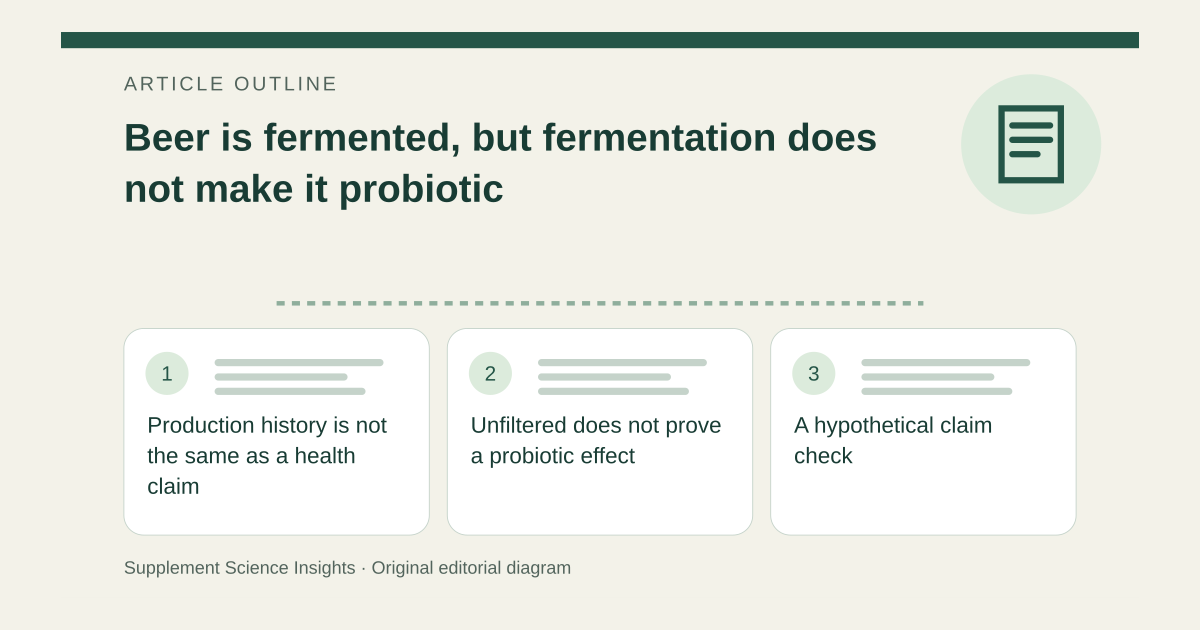
Production history is not the same as a health claim
The ISAPP fermented-food consensus discusses beer as a fermented beverage. Its fermented status describes how it is made. The probiotic definition adds requirements about living microorganisms and demonstrated health benefit; it is not satisfied merely because yeast participated in brewing. [1][2]
Unfiltered does not prove a probiotic effect
Even if a beer contains viable yeast or bacteria, their presence alone does not establish a strain-specific benefit. A label such as unfiltered cannot substitute for organism identification, viable quantity and relevant evidence. These sources do not establish a best beer for gut health or justify choosing alcohol as a probiotic treatment. [2]
A hypothetical claim check
Imagine two beers differ in whether live yeast remains. That difference concerns product microbiology. To claim that either prevents a digestive condition would require additional evidence about the actual organism, amount and outcome. The word fermented does not supply that missing clinical evidence. [2]
| Claim | What remains to establish |
|---|---|
| Fermented beer | How it was produced |
| Contains live yeast | Identity and viable amount |
| Probiotic benefit | Evidence for the specific organism and use |
Sources for this article
- The International Scientific Association for Probiotics and Prebiotics (ISAPP) consensus statement on fermented foods | Nature Reviews Gastroenterology & Hepatology
Source consulted: 2026-09-20. This is a reference resource, not a claim that we conducted the studies or tested a product. - Probiotics - Health Professional Fact Sheet
Source consulted: 2026-09-20. This is a reference resource, not a claim that we conducted the studies or tested a product.