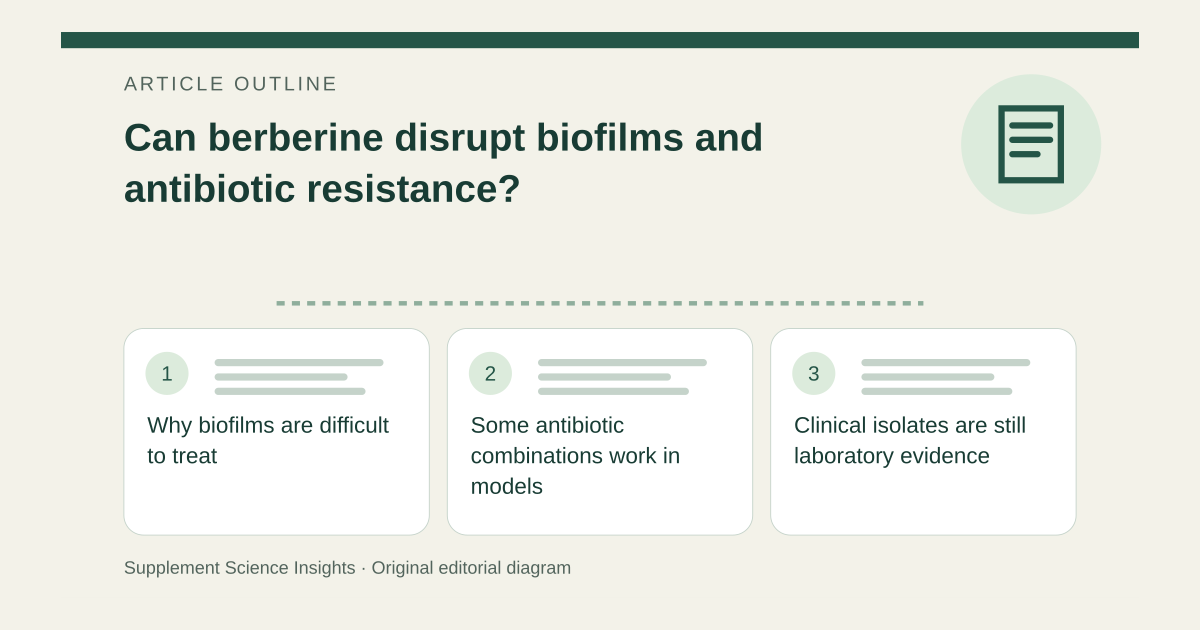
Why biofilms are difficult to treat
Biofilms are microbial communities embedded in a protective matrix. The reviewed research examines berberine effects on adhesion, microbial communication, matrix formation and efflux pumps that move substances out of cells. These mechanisms make it a research candidate, not a general-purpose biofilm cleanse. [1]
Some antibiotic combinations work in models
The 2026 review describes laboratory and animal experiments in which berberine enhances antibiotic activity. Effects depend on the organism, drug, concentration and delivery method. A successful combination in a dish cannot establish that an oral capsule reaches an infected implant, lung or wound at the required exposure. [1]
Clinical isolates are still laboratory evidence
The review’s section on clinical translation includes experiments using isolates or ex vivo biofilms from patients. Those do not constitute randomized treatment trials showing infection cure. The authors explicitly identify inadequate clinical evidence, uncertain dosing and pharmacokinetic barriers. [1]
Do not design an antibiotic adjunct at home
Persistent or resistant infection needs organism- and site-specific medical management. Berberine may also interact with medicines. Imagine an isolate becomes more sensitive to an antibiotic in an experiment: that result supports further investigation, not independently adding a retail supplement to a prescription. [1][2]
| Experiment | What it establishes |
|---|---|
| Biofilm reduced in a dish | Activity at tested conditions |
| Animal infection improves | Preclinical treatment signal |
| Patient-derived isolate responds | Still not a patient cure |
| Retail oral supplement | Clinical regimen remains unvalidated |
Sources for this article
- Berberine Interferes with the Molecular Landscape of Biofilm-Driven Pathogenicity - PMC
Source consulted: 2026-09-21. This is a reference resource, not a claim that we conducted the studies or tested a product. - Berberine and Weight Loss: What You Need To Know | NCCIH
Source consulted: 2026-09-21. This is a reference resource, not a claim that we conducted the studies or tested a product.