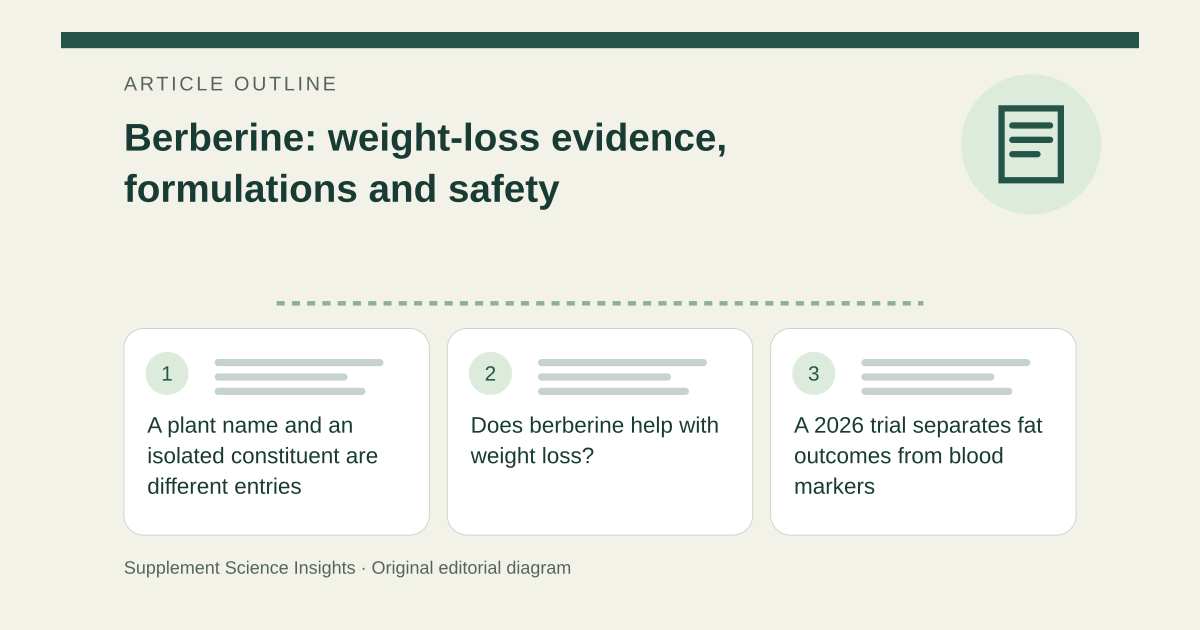
A plant name and an isolated constituent are different entries
Berberine occurs in several plants, including barberry, goldenseal and Oregon grape. NCCIH describes studies using varied amounts and formulations. A plant-containing product and a specified berberine preparation should not be treated as the same intervention without supporting detail. [1]
Copy the exact extract or constituent name, declared quantity, serving size and any stated standardization. Do not assume that the total weight of plant material describes the quantity of berberine it contains. [1]
Does berberine help with weight loss?
Berberine is being studied for weight and metabolic outcomes, but NCCIH says there is not enough rigorous clinical evidence to determine whether it is effective for weight loss. Many studies have important limitations, and benefits reported for blood glucose or lipids should not be rewritten as a proven weight-loss outcome. [1]
“Nature’s Ozempic” is a marketing comparison, not evidence of therapeutic equivalence. A possible cellular mechanism does not show the same clinical effect, safety profile or approved use as a prescription GLP-1 medicine. Do not replace prescribed treatment on the basis of that phrase. [1]
A 2026 trial separates fat outcomes from blood markers
A randomized trial enrolled 337 adults without diabetes who had obesity and metabolic dysfunction-associated steatotic liver disease. Berberine 1 g daily for six months did not significantly improve the primary visceral-fat or liver-fat outcomes compared with placebo. Some blood markers improved, but those secondary changes do not establish a fat-loss benefit. [2]
The population and preparation matter: this finding does not answer every metabolic question about berberine, and it does not compare berberine directly with a GLP-1 medicine. It does show why a claim about weight or abdominal fat should be checked against an actual clinical outcome, not only a proposed mechanism. [2]
Does better absorption mean a better result?
Berberine hydrochloride, phytosome preparations and dihydroberberine should be treated as distinct interventions. An absorption study can show differences in measured exposure; it cannot by itself establish greater weight loss, better long-term diabetes outcomes or fewer adverse effects.
For a formulation claim, look for a human comparison using the exact preparation, a relevant clinical outcome and adequate follow-up. If the only result is a blood concentration after a dose, describe that result as pharmacokinetic evidence. Do not translate it into an equivalent treatment dose or a multiple of clinical effectiveness.
Which safety questions come before a product ranking?
NCCIH lists abdominal pain, constipation, diarrhea, nausea and vomiting among common adverse effects. Berberine can interact with medicines, including cyclosporine. A full medication review matters more than assuming that spacing the doses will eliminate an interaction. [1]
Berberine should not be used during pregnancy or breastfeeding or given to infants. It can affect bilirubin handling and has been associated with dangerous bilirubin buildup in infants. A blend containing berberine still requires the same safety assessment; an added “absorption enhancer” is another ingredient to review. [1]
How to evaluate a berberine label and testing claim
Compare the exact chemical or extract form, amount per serving, serving units and all co-ingredients. Keep the quantity of an entire proprietary blend separate from the amount of berberine. If the individual amount is undisclosed, the product cannot be matched reliably to a study dose.
Look for a current report identifying the tested product or batch, laboratory, identity method and contaminant results. A manufacturing certificate is not the same as a batch assay, and a clean assay is not proof of weight-loss efficacy. No current “best value” winner can be inferred from an old price, a brand reputation claim or a bestseller list.
Medicine interactions and infant exposure matter
NCCIH identifies gastrointestinal side effects and medicine interactions, including an interaction with cyclosporine. It describes berberine as likely unsafe for infants and potentially unsafe during pregnancy or breastfeeding because of possible harm to the fetus or infant. [1]
Discuss the exact preparation with a clinician before use, particularly when taking medicines. Do not replace prescribed diabetes, transplant or other treatment with a product advertised as a natural alternative. This page provides no regimen or strategy for combining it with medicines. [1]
State what a percentage refers to before multiplying
An invented label declares 500 mg of an extract and explicitly specifies 20 percent berberine by weight within that extract. Under that stated assumption, the declaration corresponds to 100 mg berberine: 500 multiplied by 0.20.
The calculation interprets a fictional declaration; it does not verify the batch or suggest an intake. If the percentage referred to something else, or its basis were missing, this calculation would not be justified. A plant name alone cannot supply the missing percentage.
| Field | Example |
|---|---|
| Extract amount | 500 mg |
| Explicit berberine content by weight | 20 percent of that extract |
| Calculated declared berberine | 500 mg × 0.20 = 100 mg |
| Actual batch assay or appropriate intake | Not established |
Do not turn preliminary weight findings into a promise
NCCIH describes weight-loss evidence as inconclusive, noting inconsistent findings, risk of bias and differences in formulations and participant health. Those limitations matter when comparing a broad marketing claim with the research that actually exists. [1]
Before adopting a narrower claim, inspect the original trial’s population, comparator, preparation, planned outcome and harms. A result in a selected disease group does not automatically predict weight change in a different reader. [1]
Preserve the distinction between a label and a measurement
Record the manufacturer’s declaration separately from any laboratory result. Include the exact ingredient wording and the source of any percentage or conversion. A calculation based on a declaration remains a calculation, even when its arithmetic is correct.
For an unclear label, ask whether the amount describes extract mass, a named salt or the constituent being compared. Do not invent a salt-to-constituent conversion or borrow an assay value from another brand.
How to use this evidence
Use the sections above to match a question with the preparation, population and outcome actually studied. Follow the related reading for more detailed questions; a useful comparison may still end with uncertainty rather than a winning product.
This is an editorial evidence guide, not a systematic review or individual medical advice. No new clinical review credentials, product tests or personal treatment plan are implied. Study protocols and fictional value examples are identified as such.
How does baseline blood pressure affect the evidence question?
Record the starting blood pressure, diagnosis and background treatment before comparing a result. An earlier berberine review combined different settings, including adding berberine to existing medicines and comparing it with active treatments. A 2025 review restricted to placebo-controlled trials of metabolic-syndrome components found no significant overall effect on systolic or diastolic blood pressure. [3][4]
These summaries do not provide a threshold that predicts an individual response or a baseline-risk calculation for preventing stroke or heart attack. A change in a blood-pressure measurement is not the same endpoint as fewer cardiovascular events. Differences in populations and co-treatment also prevent an add-on result from proving that berberine can replace prescribed blood-pressure care. [3][4]
Sources for this article
- NIH NCCIH — Berberine and Weight Loss: What You Need To Know
Source consulted: 2026-09-17. This is a reference resource, not a claim that we conducted the studies or tested a product. - Berberine and Adiposity in Diabetes-Free Individuals With Obesity and MASLD: A Randomized Clinical Trial
Source consulted: 2026-10-28. This is a reference resource, not a claim that we conducted the studies or tested a product. - Lan et al. — Berberine for diabetes, lipids and hypertension: meta-analysis
Source consulted: 2026-10-28. This is a reference resource, not a claim that we conducted the studies or tested a product. - Berberine and metabolic-syndrome components: randomized placebo-controlled trial meta-analysis
Source consulted: 2026-10-28. This is a reference resource, not a claim that we conducted the studies or tested a product.
Considering a supplement?
Ingredient evidence alone does not establish which retail product is suitable. No single featured product is recommended for this article.
Compare matched label and package information; no featured product or clinical efficacy winner is selected.
Compare three berberine formulations → No overall winner
THORNE Berberine: product dossier
Double Wood Berberine HCl 500 mg: product dossier
Nutricost Berberine HCl: product dossier
Compare formulations → · How we select products