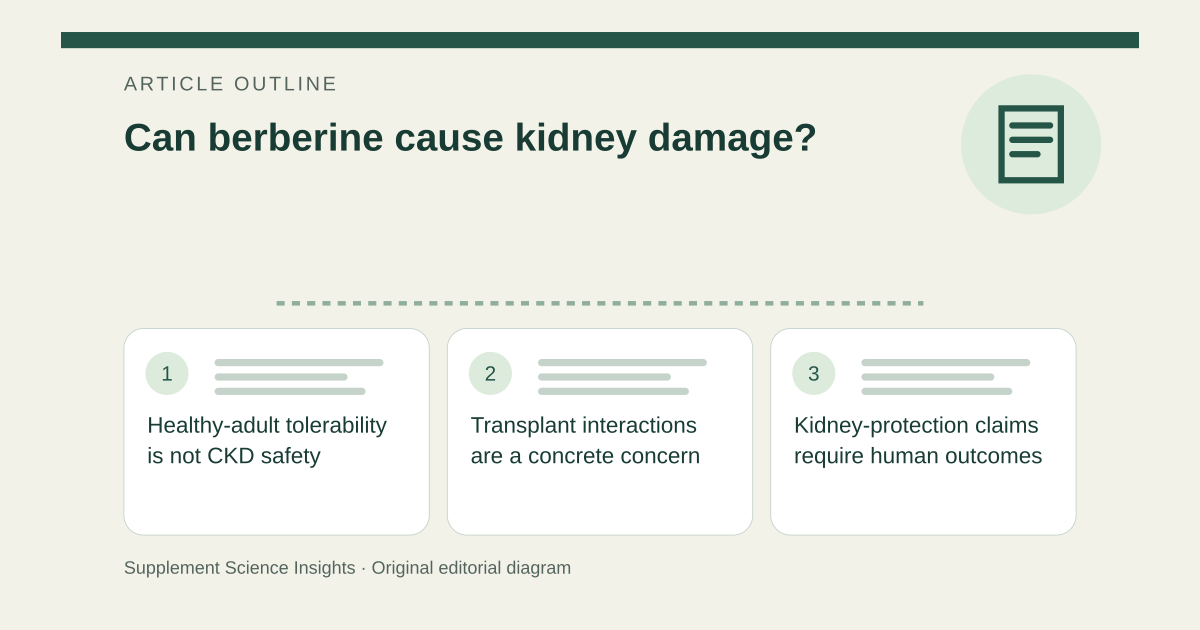
Healthy-adult tolerability is not CKD safety
NCCIH primarily describes gastrointestinal adverse effects and medicine interactions. Short studies in selected people do not establish safety at every stage of kidney disease. NKF notes that herbal products may worsen kidney problems, contain contaminants or interact with prescribed treatment. [1][2]
Transplant interactions are a concrete concern
Berberine has been shown to interact with cyclosporine. MSK also describes a reported tacrolimus interaction associated with renal toxicity. These findings concern altered exposure to important medicines; they do not demonstrate that every berberine user will develop direct kidney injury. A transplant recipient should not adjust anti-rejection medicine independently. [1][3]
Kidney-protection claims require human outcomes
Laboratory mechanisms or results in disease models cannot establish that a supplement prevents kidney failure or safely treats CKD. The NKF guidance emphasizes how often supplement evidence does not include people with kidney disease. A kidney-detox label supplies neither an effective dose nor a reliable safety assessment. [2]
Review the product and kidney status together
Bring the ingredient list, dose, other medicines and recent kidney results to the kidney team. Combination products can make it harder to identify exposures. Do not infer safety from a natural label or from the fact that another person tolerated the same brand. [2]
An interaction can matter without immediate symptoms
Imagine a transplant recipient starts berberine while feeling well. The absence of nausea does not show that their anti-rejection drug level is unchanged. Contact the transplant team for assessment of the supplement and any needed monitoring rather than waiting for obvious illness. [2][1]
| Claim | Necessary distinction |
|---|---|
| Well tolerated in one trial | Not safety in advanced CKD |
| Changed transplant-drug exposure | Potential interaction-mediated harm |
| Animal kidney benefit | Not prevention of human kidney failure |
| Natural product | Still needs ingredient and medicine review |
Sources for this article
- Berberine and Weight Loss: What You Need To Know | NCCIH
Source consulted: 2026-09-21. This is a reference resource, not a claim that we conducted the studies or tested a product. - “Kidney Detox” and Herbal Supplements: What’s Safe and What’s Not | National Kidney Foundation
Source consulted: 2026-09-21. This is a reference resource, not a claim that we conducted the studies or tested a product. - Berberine | Memorial Sloan Kettering Cancer Center
Source consulted: 2026-09-21. This is a reference resource, not a claim that we conducted the studies or tested a product.