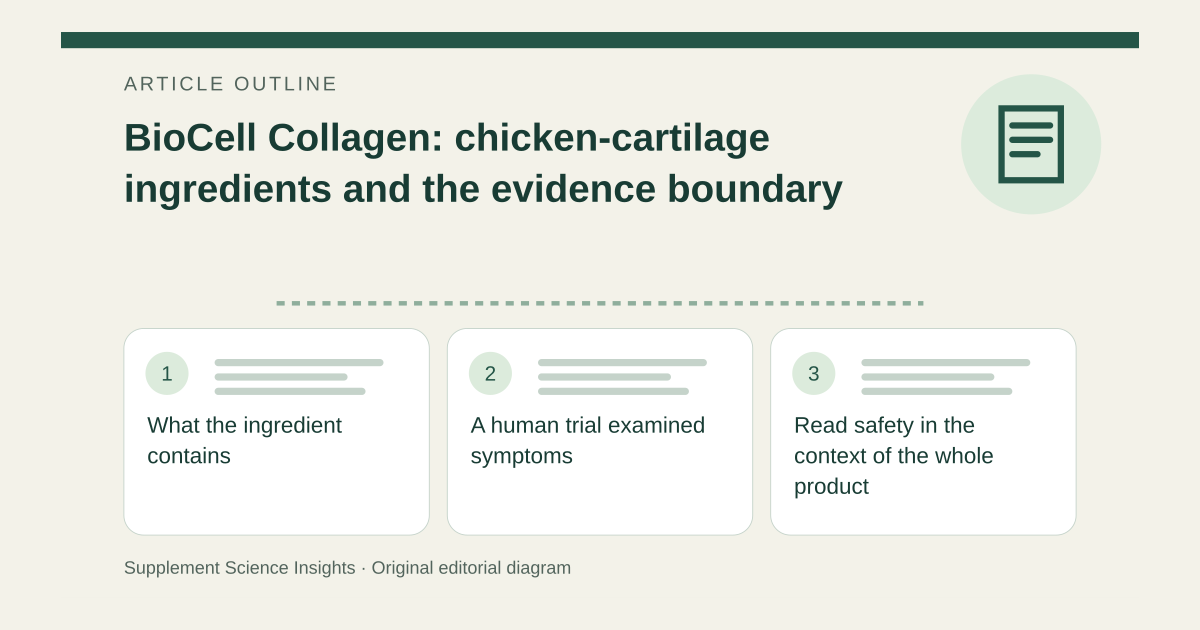
What the ingredient contains
The manufacturer identifies chicken sternal cartilage as the source and describes a naturally occurring mixture of type II collagen peptides, chondroitin sulfate and hyaluronic acid. Hydrolysis changes the collagen into smaller components. The type II origin does not make the preparation interchangeable with an undenatured collagen product. [1]
A human trial examined symptoms
A 2012 randomized double-blind trial compared 2 g daily with placebo for 70 days in 80 people with physician-verified hip or knee osteoarthritis. The abstract reports improvements in pain and function scores and comparable tolerability. It does not establish cartilage regeneration, long-term disease modification or the contribution of each component separately. Full funding, attrition and detailed safety information were unavailable in the inspected abstract. [2]
Read safety in the context of the whole product
Comparable tolerability in 80 participants is not a guarantee against rare reactions. The ingredient is chicken-derived, and a retail product may add other substances. Imagine two bottles both say type II collagen: compare whether they contain hydrolyzed cartilage or undenatured collagen before treating their amounts or studies as equivalent. [1][2][3]
| Observation | Interpretation |
|---|---|
| Chicken cartilage origin | Animal-source ingredient |
| Hydrolyzed type II peptides | Not undenatured collagen |
| Symptom-score improvement | Not structural regrowth |
Sources for this article
- bio cell collagen – Biocell Technology
Source consulted: 2026-09-20. This is a reference resource, not a claim that we conducted the studies or tested a product. - Effect of the novel low molecular weight hydrolyzed chicken sternal cartilage extract, BioCell Collagen, on improving osteoarthritis-related symptoms: a randomized, double-blind, placebo-controlled trial.
Source consulted: 2026-09-20. This is a reference resource, not a claim that we conducted the studies or tested a product. - Dietary Supplements: What You Need to Know
Source consulted: 2026-09-20. This is a reference resource, not a claim that we conducted the studies or tested a product.