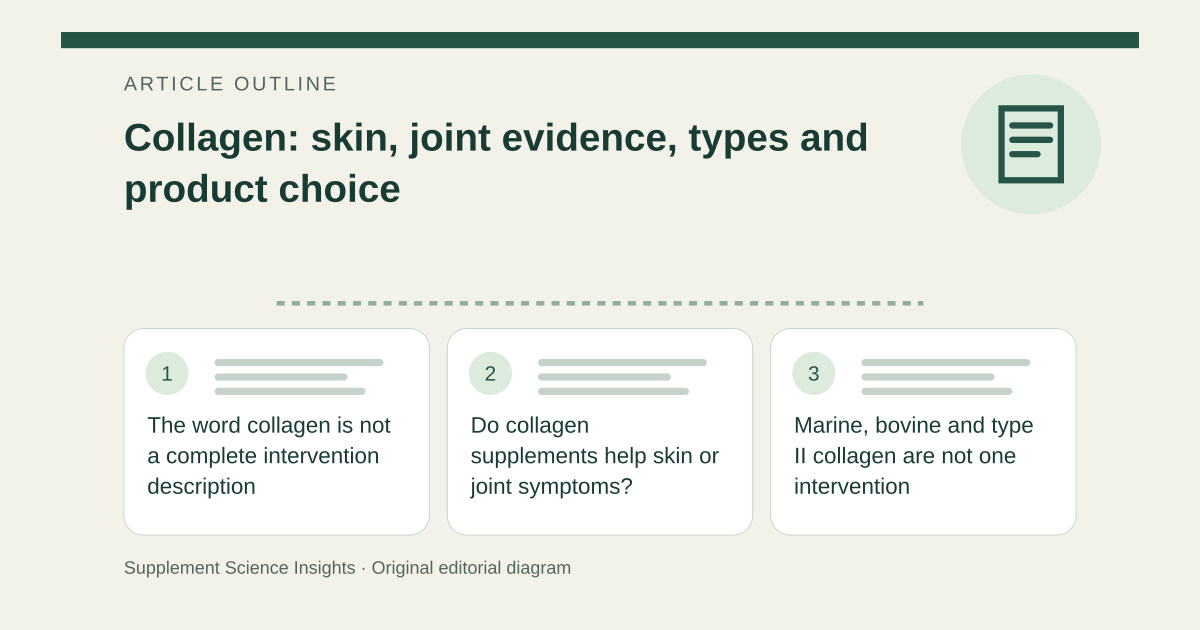
The word collagen is not a complete intervention description
Research has examined different collagen preparations, including peptides in a drink and undenatured type II collagen in a supplement. The two original studies linked here illustrate why the preparation and intended outcome need to stay visible. [1][2]
Record whether a label describes a hydrolysate or peptides, an undenatured preparation, or a blend. Preserve the named source, amount and other ingredients. Do not replace those details with a broad category such as “joint collagen” or “beauty collagen.” [1][2]
Do collagen supplements help skin or joint symptoms?
Skin hydration, wrinkle measurements and knee symptoms are different outcomes. The 2019 Bolke trial reported improvements in measured skin properties with a combination drink over 12 weeks, but the additional ingredients prevent attributing the result solely to collagen. In the 2016 Lugo knee trial, the undenatured type II collagen group improved on the WOMAC symptom measure compared with placebo over 180 days. [1][2]
These are preparation-specific findings from industry-funded trials. They do not establish that every collagen powder works, that a skin result treats joint pain or that improved symptoms demonstrate cartilage regrowth. Keep the comparison group, formulation and funding visible beside the result. [1][2]
Marine, bovine and type II collagen are not one intervention
The source animal, collagen type and processing describe different properties. Hydrolyzed peptides and undenatured type II collagen should not be compared by milligram count alone. “Type I and III” or “multi-collagen” on a label does not demonstrate that the swallowed protein is delivered intact to a chosen tissue. [1][2][3]
Choose a source compatible with dietary restrictions and allergies, then assess the evidence for the actual preparation. Marine origin does not establish superiority over bovine collagen. A vegan product marketed as a collagen builder needs its own ingredient assessment; it should not inherit trials of animal collagen peptides. [1][2][3]
How much collagen, and how long before results?
There is no universal collagen dose for skin, joints, hair, bone and muscle. The skin combination trial used 2.5 g collagen peptides daily for 12 weeks; the knee trial used a 40 mg undenatured type II collagen preparation for 180 days. These are study protocols, not interchangeable recommended servings. [1][2]
An outcome assessed after several months does not guarantee a visible change by that date. The cited trials do not establish that taking collagen at bedtime, on an empty stomach or in coffee is superior. Choose the outcome and preparation first, then judge the matching evidence rather than applying one schedule to every goal. [1][2]
How to compare powders, capsules, drinks and value
Read the declared collagen amount per serving, source, preparation and added ingredients. Count how many capsules or gummies make a serving before comparing them with a scoop. A ready-to-drink product may add convenience, sweeteners or micronutrients; those features are different from a stronger collagen effect.
For a fictional $30 container supplying 30 servings of 5 g collagen, the cost is $1 per serving and $0.20 per gram. That arithmetic does not establish an effective dose, a current market price or clinical superiority. Verify exact-product testing and allergen information independently; a claim that the raw ingredient was studied does not verify the finished batch.
A skin study may test more than collagen alone
A 2019 trial by Bolke and colleagues studied 72 women aged 35 or older for 12 weeks. Its drink combined collagen peptides with acerola extract and several micronutrients. It measured skin properties and was funded by Quiris Healthcare; the authors reported no conflicts and no sponsor influence on execution or analysis. [1]
That design tests the specified combination. It cannot isolate the contribution of collagen from the additional ingredients. The selected population and short observation period also limit what can be inferred about other people or long-term use. [1]
A skin endpoint does not answer a knee-pain question
Imagine Label A describes hydrolyzed collagen peptides and cites a study measuring skin hydration. Label B describes undenatured type II collagen and cites a study measuring knee symptoms. These invented labels point to different preparations and questions.
Neither a shared ingredient family nor a larger number of milligrams makes one answer the other’s question. Keep each preparation paired with its own outcome, population and comparison group. The example names no winning product and supplies no recommended intake.
| Field | Label A | Label B |
|---|---|---|
| Preparation | Hydrolyzed collagen peptides | Undenatured type II collagen |
| Cited outcome | Skin hydration | Knee symptoms |
| Evidence transferable to the other label | Not established | Not established |
| Product winner | Not determined | Not determined |
Keep joint research tied to its actual participants
The 2016 trial by Lugo and colleagues randomized 191 people with knee osteoarthritis to three groups, including undenatured type II collagen and placebo. InterHealth Nutraceuticals sponsored the study; two authors were employees and another provided consulting services. [2]
This is a different intervention and population from the skin study. The funding relationships should remain visible, and a knee-symptom outcome should not be rewritten as proof of rebuilding cartilage or improving skin. No clinical effect estimate is endorsed here. [2]
Ask what the exact preparation contains
Keep the ingredient source and all co-ingredients visible, especially when discussing food allergies or suitability with a clinician. If the source is not disclosed, ask the manufacturer rather than assuming that all collagen products use the same material. [3][4]
A study of one preparation does not verify another product’s identity, purity or batch consistency. Ask whether a quality report corresponds to the actual product and batch. Evidence about composition and evidence about clinical benefit answer separate questions. [3][4]
How to use this evidence
Use the sections above to match a question with the preparation, population and outcome actually studied. Follow the related reading for more detailed questions; a useful comparison may still end with uncertainty rather than a winning product.
This is an editorial evidence guide, not a systematic review or individual medical advice. No new clinical review credentials, product tests or personal treatment plan are implied. Study protocols and fictional value examples are identified as such.
What should collagen contaminant testing actually verify?
Animal source creates questions to check, not a contamination verdict. First identify the tissue source and relevant allergens. Separately ask what the finished product or batch was tested for: identity, the declared constituents, specified metals and microbial contamination are different test questions. A statement that an ingredient is marine or bovine cannot supply those results. [4][3]
Match a report to the exact product or lot, laboratory, methods and limits used. A raw-material report is not automatically a report on the finished flavored blend. Neither a source label nor a quality seal establishes absence of every risk, clinical effectiveness or suitability for someone with an allergy. This is a verification checklist, not a finding that one animal source is cleaner than another. [4][3]
Do grass-fed, pasture-raised or wild-caught labels prove better results?
These phrases describe claimed sourcing or production practices; they do not themselves measure skin hydration, joint pain or muscle outcomes. A clinical claim still needs a matching preparation and human outcome study. Likewise, a husbandry or capture claim is not a finished-batch contaminant test. [4]
For a sustainability claim, identify exactly what is asserted, who verifies it and what the verification covers: the animal source, fishery, ingredient supply chain, packaging or something else. Keep a documented claim separate from a complete environmental comparison. This page does not establish a life-cycle winner between marine and bovine products or assume that a premium label improves clinical effectiveness. [4]
Do flavored collagen products contain unnecessary additives?
“Flavored” does not identify the full formula or determine which ingredients are useful for you. Read the actual sweetener, flavoring, allergen and added-nutrient declarations, and compare the collagen amount per complete serving. An unflavored product can also contain additional ingredients. [4][3]
Whether an addition is wanted depends on the purpose and person; it is different from whether that ingredient is disclosed or supported by a health claim. Without a dated product sample, this page cannot say how often flavored products contain a particular additive. Do not infer a category-wide safety or quality ranking from flavor alone. [4][3]
Sources for this article
- Bolke et al. (2019) — A Collagen Supplement Improves Skin Hydration, Elasticity, Roughness, and Density
Source consulted: 2026-09-17. This is a reference resource, not a claim that we conducted the studies or tested a product. - Lugo et al. (2016) — Efficacy and tolerability of an undenatured type II collagen supplement in modulating knee osteoarthritis symptoms
Source consulted: 2026-09-17. This is a reference resource, not a claim that we conducted the studies or tested a product. - FDA — Have Food Allergies? Read the Label
Source consulted: 2026-09-17. This is a reference resource, not a claim that we conducted the studies or tested a product. - NIH ODS — Dietary Supplements: What You Need to Know
Source consulted: 2026-09-17. This is a reference resource, not a claim that we conducted the studies or tested a product. - Clark et al. — Collagen hydrolysate in athletes with activity-related joint pain
Source consulted: 2026-10-28. This is a reference resource, not a claim that we conducted the studies or tested a product.