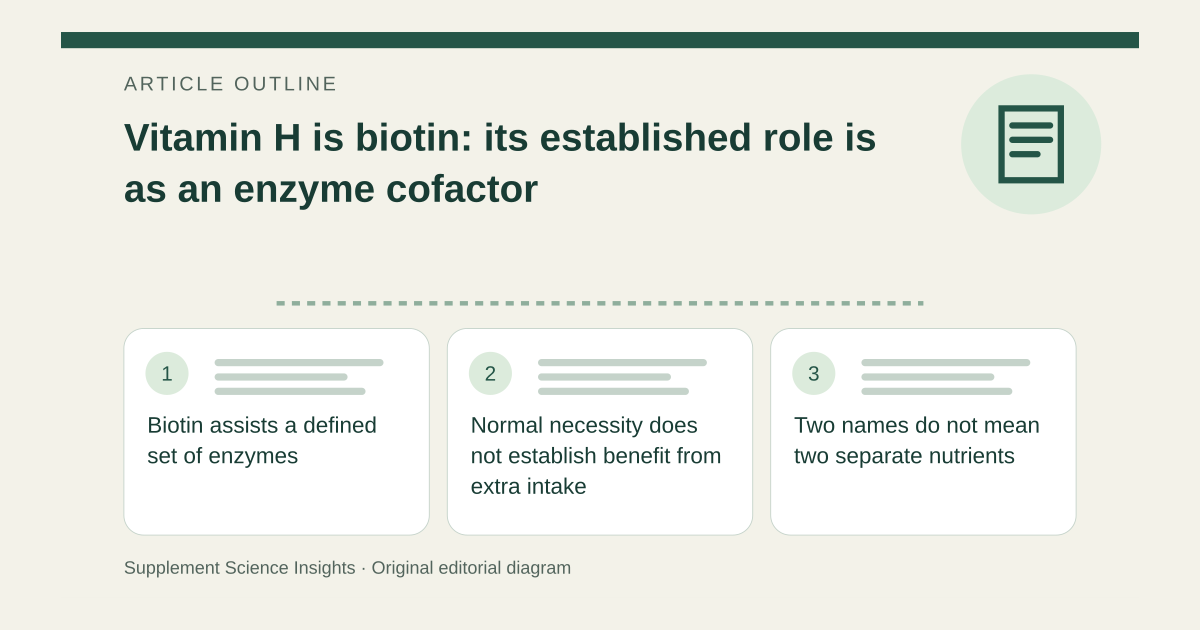
Biotin assists a defined set of enzymes
NIH ODS identifies biotin as a cofactor for five carboxylases involved in fatty-acid, glucose and amino-acid metabolism. A cofactor supports enzyme function; it is not itself a supply of extra calories or a universal accelerator of metabolism. [1][2]
The alternative name vitamin H does not identify an additional vitamin that must be taken separately from biotin. [1][2]
Normal necessity does not establish benefit from extra intake
A nutrient can be essential while extra supplementation remains unproven for a particular cosmetic goal. Demonstrating improved hair or nails requires evidence about people, the intervention and the measured outcome. [1]
Do not treat the enzyme role as a dose recommendation or assume a larger amount means faster results. The product’s full formulation and any relevant testing precautions still matter. [1]
Two names do not mean two separate nutrients
Imagine one label says biotin and another says vitamin H. Those names refer to the same vitamin, so combining them should not be interpreted as supplying two different essential nutrients.
| Detail | Interpretation |
|---|---|
| Vitamin H | Another name for biotin |
| Cofactor | Supports specific enzymes |
| Cosmetic benefit | Requires separate evidence |
Sources for this article
- Biotin - Health Professional Fact Sheet
Source consulted: 2026-09-17. This is a reference resource, not a claim that we conducted the studies or tested a product. - Definition of biotin - NCI Dictionary of Cancer Terms - NCI
Source consulted: 2026-09-17. This is a reference resource, not a claim that we conducted the studies or tested a product.