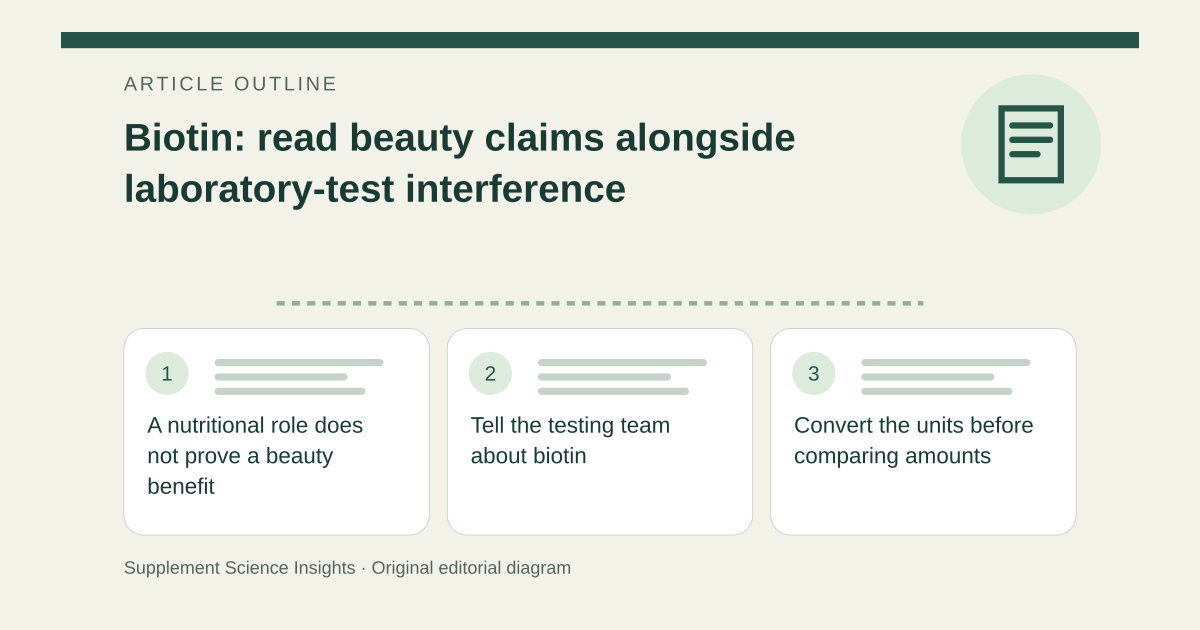
A nutritional role does not prove a beauty benefit
Biotin is an essential B vitamin involved in metabolism. NIH describes limited evidence for hair, skin and nail supplement claims, much of it from small studies or case reports. Evidence about a deficiency condition should not be generalized to everyone with a cosmetic concern. [1]
Ask whether the study population, baseline status and measured outcome match the advertised claim. A photograph, testimonial or before-and-after observation cannot by itself establish what would have happened without the supplement. [1]
Tell the testing team about biotin
Biotin can interfere with certain laboratory assays, producing misleading results. FDA highlights falsely low troponin results in affected tests; troponin is used in assessing suspected heart injury. Not every assay has the same susceptibility. [1][2]
Tell the clinician and laboratory about biotin-containing supplements, their labeled quantities and recent use. Ask the testing team for instructions specific to the planned test. This page does not give a universal waiting period or suggest delaying urgent medical assessment. [1][2]
Convert the units before comparing amounts
Consider fictional labels A and B: A states 5,000 mcg biotin per serving and B states 5 mg per serving. Since 1 mg equals 1,000 mcg, these declare the same mass, despite very different printed numbers.
A third label stating 500 mcg declares 0.5 mg, one tenth of either example above. These are arithmetic examples, not tested products, suggested intakes or thresholds for laboratory interference. Equal amounts also do not prove equal quality or benefit.
| Label | Printed amount | Equivalent mass |
|---|---|---|
| A | 5,000 mcg | 5 mg |
| B | 5 mg | 5,000 mcg |
| C | 500 mcg | 0.5 mg |
Give the laboratory a useful product record
A practical record contains the product name, a legible nutrient-panel photo, biotin amount with units, serving size and when the product was last used. Include multivitamins and combination beauty products rather than only a bottle named “biotin.” [2]
The testing team can interpret that information in relation to its assay and clinical question. A general online article cannot infer the laboratory platform from the name of a blood test or tell whether a particular result was affected. [2]
Keep evidence of benefit and testing concerns separate
Lack of a proven cosmetic benefit does not make laboratory interference irrelevant; conversely, an interference warning does not show that every biotin user has an inaccurate test. The important distinction is between a claim about a clinical outcome and a property of a particular assay.
The cited sources support this limited overview. This article does not provide a diagnostic algorithm, rank hair-loss treatments or independently review every original beauty study. No brand or dose is recommended, and independent scientific acceptance remains pending.
Sources for this article
- NIH Office of Dietary Supplements — Biotin: Health Professional Fact Sheet
Source consulted: 2026-09-17. This is a reference resource, not a claim that we conducted the studies or tested a product. - FDA — Biotin Interference with Troponin Lab Tests
Source consulted: 2026-09-17. This is a reference resource, not a claim that we conducted the studies or tested a product.