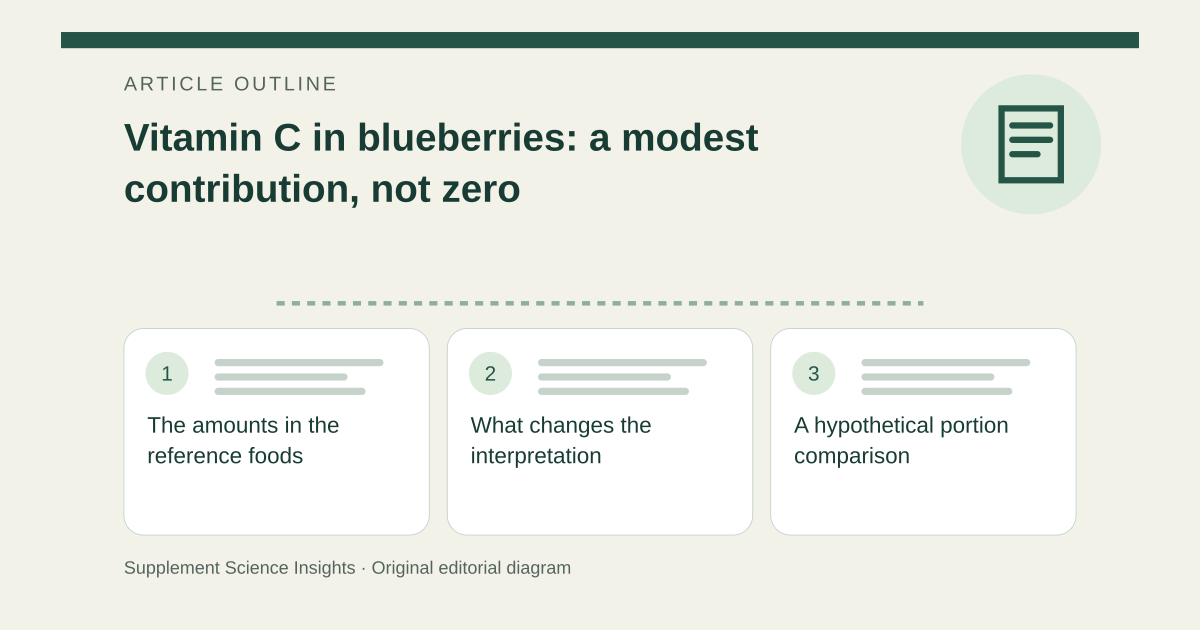
The amounts in the reference foods
USDA’s final SR Legacy 2018 release reports raw blueberries: 9.7 mg per 100 g; raw strawberries: 58.8 mg per 100 g. These are named historical reference foods, not measurements of a current package or meal. [1]
What changes the interpretation
The blueberry record gives 9.7 mg vitamin C per 100 g, compared with 58.8 mg for strawberries. This does not rank every property of the two fruits. Frozen, sweetened, cooked or dried berries require suitable entries, and the historical values are not assays of a current punnet. [1]
A hypothetical portion comparison
For hypothetical 150 g portions, the estimates are 14.55 mg from blueberries and 88.2 mg from strawberries. Both can contribute to a varied diet. The equal-weight comparison answers a vitamin C question rather than proving that the fruit with the lower value should be avoided. The table uses the explicitly chosen edible weights. Scale a matching per-100-g value by the grams eaten divided by 100; a count of pieces or an unspecified spoonful is not the same denominator. [1]
| Food | Chosen portion | Nutrient estimate |
|---|---|---|
| Raw blueberries | 150 g | 14.55 mg |
| Raw strawberries | 150 g | 88.2 mg |
Sources for this article
- USDA FoodData Central — SR Legacy April 2018 composition and portion tables
Source consulted: 2026-09-20. This is a reference resource, not a claim that we conducted the studies or tested a product.