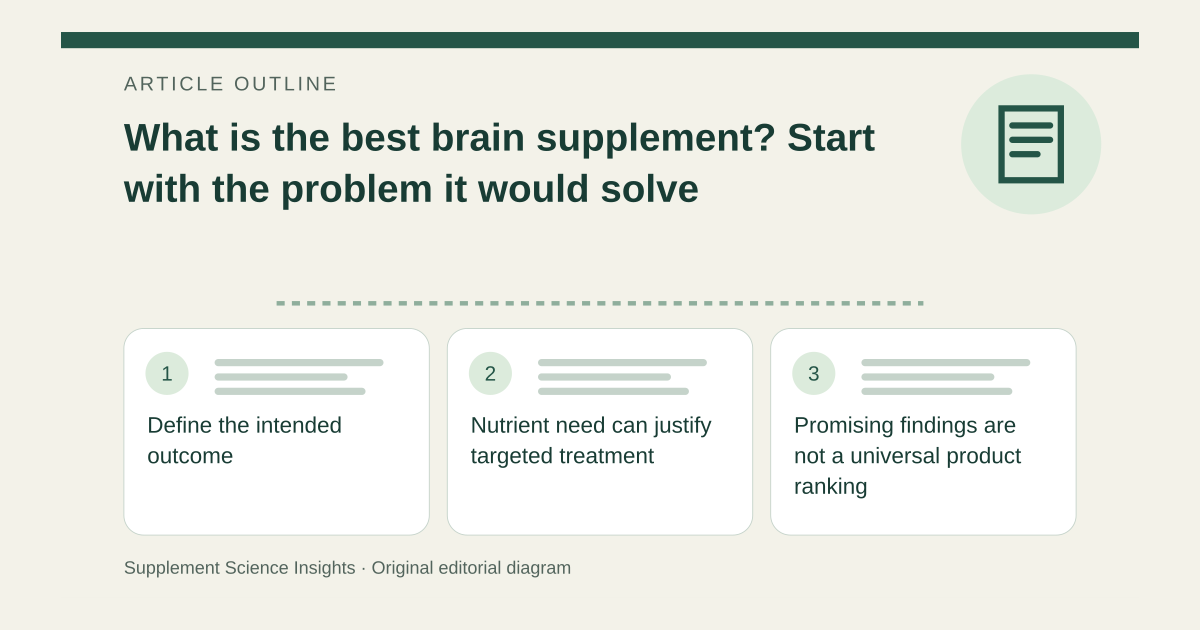
Define the intended outcome
Staying alert, remembering appointments, treating a deficiency and preventing Alzheimer disease are different goals. A study measuring one cannot settle the others. The National Institute on Aging does not recommend a vitamin or supplement as an established way to prevent Alzheimer disease or other cognitive decline. [1]
Nutrient need can justify targeted treatment
Vitamin B12 deficiency can produce neurological symptoms and needs appropriate evaluation and treatment. This does not mean extra B12 improves everyone’s memory. Review diet, absorption risks and clinical findings rather than diagnosing a deficiency from a concentration problem alone. [2]
Promising findings are not a universal product ranking
NIA discusses possible cognition or memory benefits in recent multivitamin research in older adults. Such findings do not establish dementia prevention, prove the same benefit in younger people, or validate every marketed brain blend. Keep the population and outcome attached to the claim. [1]
Consider the wider causes of cognitive difficulty
NIA emphasizes chronic-health management, medicine effects, sensory problems, physical activity and social engagement as relevant to cognitive health. New or worsening memory difficulties deserve assessment. A supplement can delay useful care if it becomes the only explanation or response. [1]
Make the purchase decision specific
Imagine a person compares three memory blends but has no identified nutrient need or defined outcome. First review symptoms, medicines and diet, then ask what evidence supports the actual product for that goal. Independent quality information can help with product composition; it cannot by itself prove a brain benefit. [3][1]
| Question | Why it matters |
|---|---|
| What outcome? | Focus and dementia prevention differ |
| Is a deficiency present? | Targeted replacement has a separate purpose |
| Which population was studied? | Results do not apply automatically to everyone |
| Is the formula supported? | Ingredient marketing is not finished-product proof |
Sources for this article
- NIA Cognitive Health and Older Adults
Source consulted: 2026-09-21. This is a reference resource, not a claim that we conducted the studies or tested a product. - Vitamin B12 - Health Professional Fact Sheet
Source consulted: 2026-09-21. This is a reference resource, not a claim that we conducted the studies or tested a product. - Dietary Supplements: What You Need to Know
Source consulted: 2026-09-21. This is a reference resource, not a claim that we conducted the studies or tested a product.