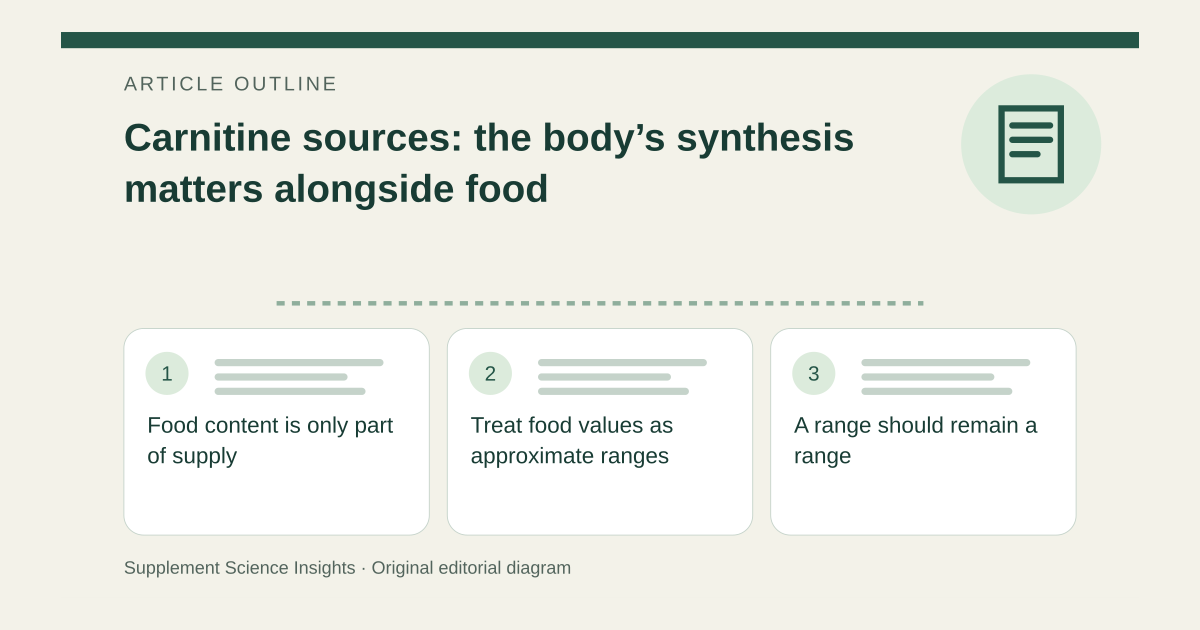
Food content is only part of supply
ODS states that healthy children and adults generally do not need to obtain carnitine from food or supplements because the liver and kidneys synthesize enough. Carnitine’s role in fatty-acid transport explains its biological importance without making it an essential dietary nutrient for everyone. [1]
This matters when comparing dietary patterns. A vegan diet may contain much less carnitine than an omnivorous diet, but that difference alone does not establish deficiency. A clinical disorder affecting production, handling or losses is a different question. [1]
Treat food values as approximate ranges
ODS lists about 42–122 mg in three ounces of cooked beef steak, 8 mg in a cup of whole milk and 2–4 mg in three ounces of cooked chicken breast. These figures come from limited food-composition data and should not be treated as exact measurements of a particular meal. [1]
The wide steak range is a reminder that a food name does not define a precise exposure. It also does not create a daily intake target or a reason to rank diets by carnitine content alone. Overall nutrition and the person’s health context matter. [1]
A range should remain a range
Imagine a food entry gives 42–122 mg for a specified portion. Recording 122 mg as though every portion contains that amount would discard the uncertainty. Retaining the range is more accurate than selecting its upper end.
| Description | Interpretation |
|---|---|
| Food composition range | Approximate dietary contribution |
| Body synthesis | Additional source |
| Lower food intake | Not automatically deficiency |
Sources for this article
- NIH ODS: Carnitine — Health Professional Fact Sheet
Source consulted: 2026-09-17. This is a reference resource, not a claim that we conducted the studies or tested a product.