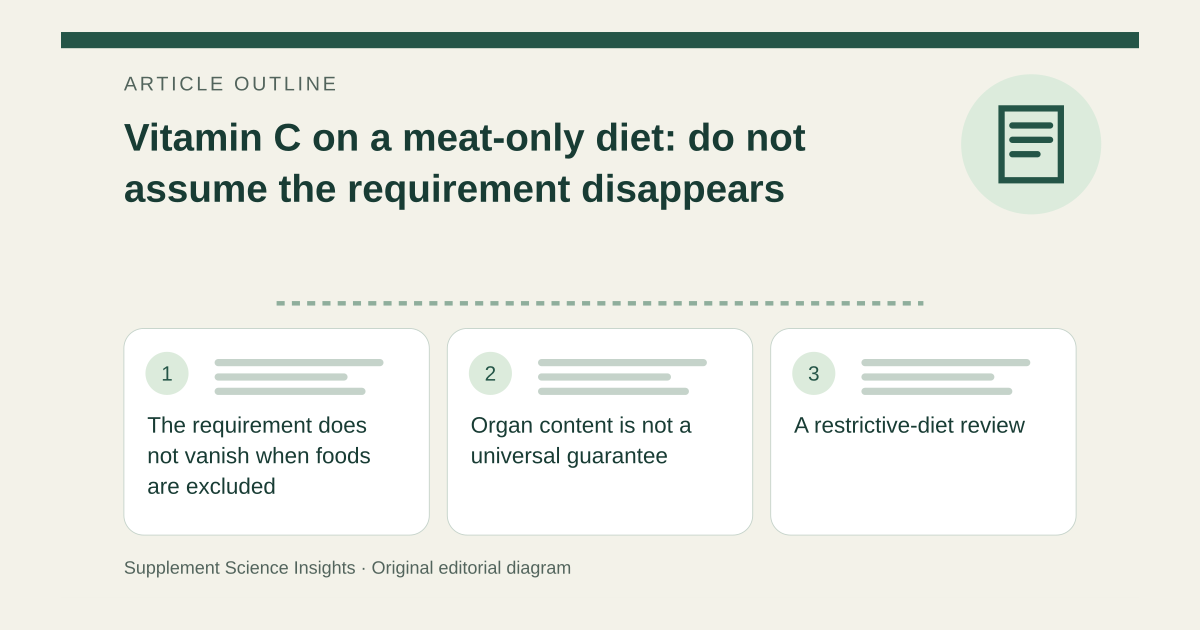
The requirement does not vanish when foods are excluded
Humans cannot synthesize vitamin C and need an external source. NIH ODS identifies fruits and vegetables as the principal food sources. The ordinary adult requirements remain relevant; a claim that carbohydrate restriction eliminates vitamin C needs is not established by the cited nutritional guidance. [1]
Organ content is not a universal guarantee
Selected historical USDA records show that some cooked organs contain vitamin C, while many ordinary meat entries contain little or none. The amount depends on the particular organ and preparation, and cooking or storage can reduce vitamin C. It is not sound to assume an unspecified serving of meat supplies enough, or to treat missing database fields as measured zero. [2][1]
A restrictive-diet review
Imagine someone excludes all fruit, vegetables and fortified foods. Review the actual foods and portions for vitamin C rather than inferring adequacy from the diet’s name. Restoring reliable food sources or discussing an appropriate supplement is more defensible than assuming no source is needed. Signs of possible deficiency warrant medical assessment; this page does not establish a safe long-term meat-only regimen. [1]
| Hypothetical claim | What to verify |
|---|---|
| Meat contains everything needed | Actual nutrient amounts and portions |
| An organ provides vitamin C | Named food and preparation |
| No external C is necessary | Contradicts the established dietary requirement |
Sources for this article
- Vitamin C - Health Professional Fact Sheet
Source consulted: 2026-09-20. This is a reference resource, not a claim that we conducted the studies or tested a product. - USDA FoodData Central — SR Legacy April 2018 composition and portion tables
Source consulted: 2026-09-20. This is a reference resource, not a claim that we conducted the studies or tested a product.