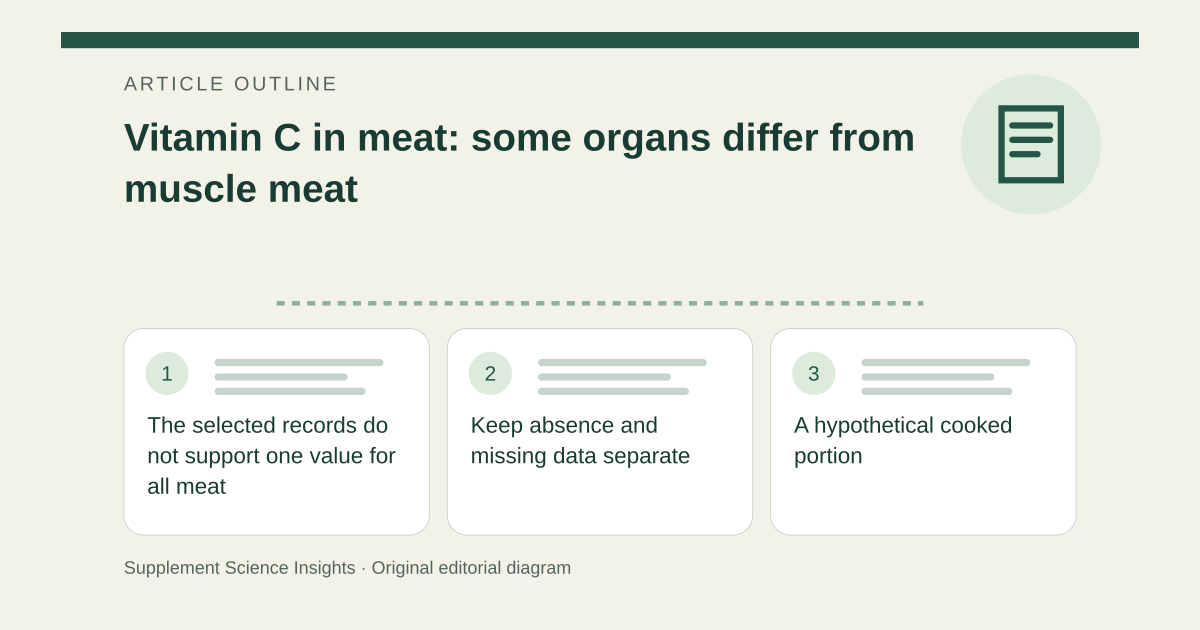
The selected records do not support one value for all meat
USDA SR Legacy lists 0 mg vitamin C per 100 g for roasted chicken breast and roasted lean pork tenderloin. In contrast, simmered chicken liver contains 27.9 mg, braised pork liver 23.6 mg and braised beef liver 1.9 mg per 100 g. The liver values differ greatly, so the word organ does not supply a reliable quantity by itself. [1]
Keep absence and missing data separate
A recorded zero is different from an unreported nutrient. These entries have vitamin C values; an unrelated food with a blank field should not be treated as zero. The data are historical food-composition estimates, and processing or storage may change the amount. They do not show that raw meat is necessary or that an organ-heavy diet meets every nutritional need. [1]
A hypothetical cooked portion
An 85 g portion of the simmered chicken-liver entry gives about 23.715 mg vitamin C, compared with 1.615 mg for the braised beef-liver entry. This comparison explains variation, not a recommendation to increase liver intake. Liver also supplies other nutrients that should not be ignored when planning repeated servings. [1]
| Cooked liver, 85 g | Vitamin C estimate |
|---|---|
| Chicken, simmered | 23.715 mg |
| Pork, braised | 20.06 mg |
| Beef, braised | 1.615 mg |
Sources for this article
- USDA FoodData Central — SR Legacy April 2018 composition and portion tables
Source consulted: 2026-09-20. This is a reference resource, not a claim that we conducted the studies or tested a product.