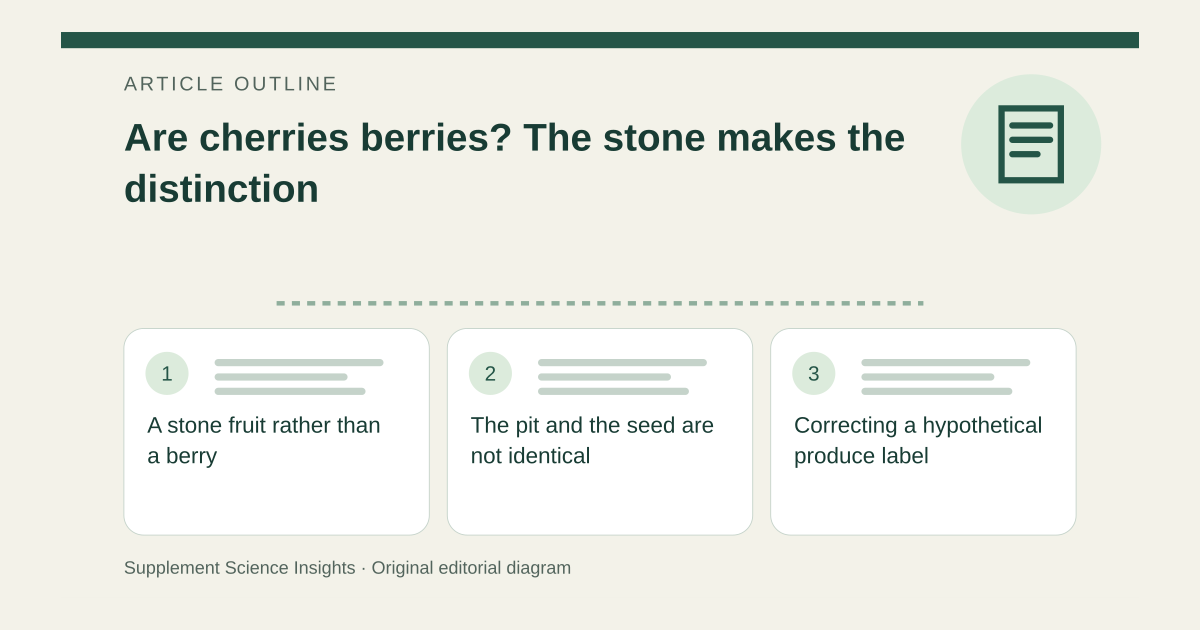
A stone fruit rather than a berry
Cherries are drupes. Their defining feature is a hard inner fruit-wall layer surrounding the seed, forming the familiar stone. Botanical berries have a different fruit-wall structure. Size alone cannot decide between these categories: a small fruit can still be a stone fruit. [1]
The pit and the seed are not identical
In careful anatomical language, the stony covering is hardened fruit-wall tissue; the seed is enclosed within it. Everyday speech often calls the whole pit a seed. Keeping the two separate explains the term stone fruit without assuming that every hard object inside a fruit has the same origin. The answer applies to classification, not to a recommendation to break open or consume pits. [1]
Correcting a hypothetical produce label
Imagine a label describes cherries as berries because they are bite-sized. Replace that shortcut with “small stone fruits.” A simple explanatory diagram can show skin, flesh and the stone enclosing the seed. The revised label answers the botanical question while leaving the familiar word cherry intact; no claim about superior nutrition follows from changing the category. [1]
| Observation | Meaning |
|---|---|
| Juicy outer flesh | Not enough to identify a berry |
| Hard stone around the seed | Characteristic of a drupe |
Sources for this article
- University of Minnesota — Fruit Morphology
Source consulted: 2026-09-20. This is a reference resource, not a claim that we conducted the studies or tested a product.