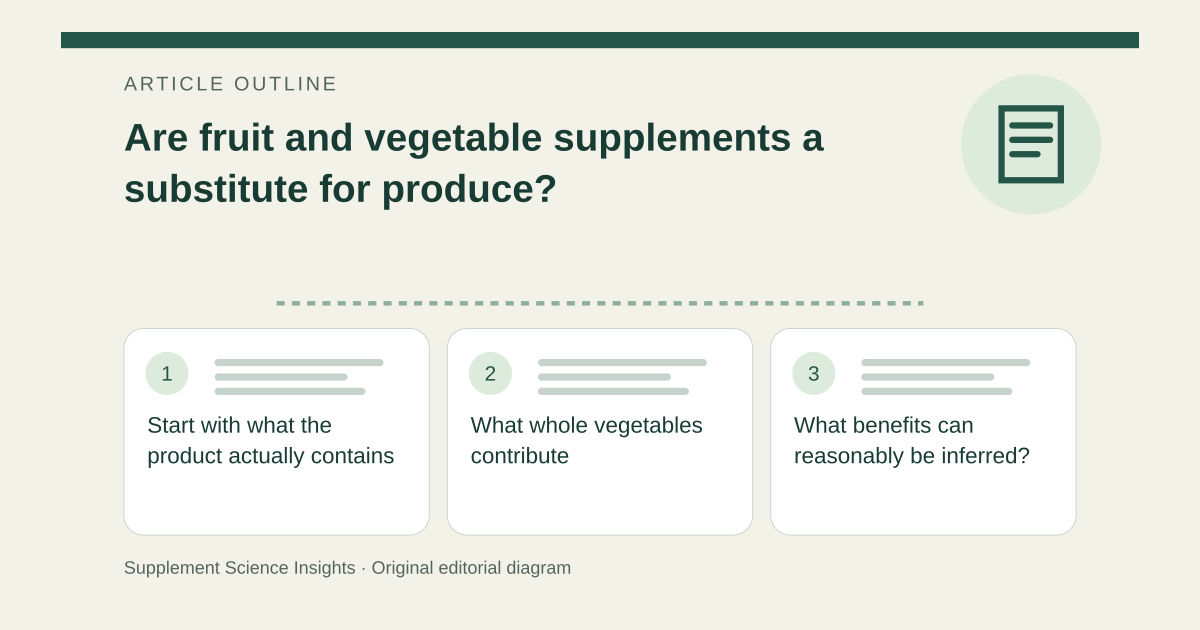
Start with what the product actually contains
Fruit and vegetable supplements may contain dried powders, extracts, added vitamins or mixtures of these. A long list of plant names does not show how much of each ingredient is present or whether the product resembles a normal serving of those foods. [1][2]
Read the serving size, declared nutrients, fiber and ingredient information. An extract can concentrate selected components while removing others. A whole-food-sounding name is therefore not enough to establish equivalence with the food from which it was made. [1][2]
What whole vegetables contribute
USDA identifies vegetables as sources of nutrients including potassium, fiber, folate and vitamins A and C. It also recognizes fresh, frozen, canned, dried and cooked forms as ways to include vegetables. Eating produce does not require only one expensive or perishable format. [3][1]
A capsule may supply a particular vitamin, but that does not automatically reproduce the food's fiber, water, volume or full nutrient pattern. The relevant comparison is the actual composition per serving, not the number of produce photographs on the package. [3][1]
What benefits can reasonably be inferred?
A supplement can be useful for addressing a specific nutrient need when its contents and use are appropriate. That is different from proving that a mixed produce powder provides the same long-term health effects as eating a varied diet rich in fruits and vegetables. [1]
NIH explains that supplements cannot take the place of the variety of foods important to a healthy eating pattern. A study of one ingredient or one biomarker should not be presented as proof of every advertised benefit of a multicomponent blend. The formulation and outcome must match. [1]
Quality and excess still matter
Check for overlapping vitamins and minerals if several products are taken together. Concentrated ingredients can contribute meaningful amounts even when the front label emphasizes food origin. Quality testing can help answer identity and contamination questions, but it does not establish clinical effectiveness. [1]
No brand is recommended here because the broad category does not define one composition or evidence base. A dietary gap is better described specifically—such as low intake of particular foods or a documented nutrient problem—than assumed from a general wellness claim. [1]
A hypothetical replacement claim
Imagine a capsule advertises ten vegetables but lists no meaningful fiber amount. The ingredient count does not make it nutritionally equivalent to ten servings of vegetables. Compare the declared contents with the intended food replacement and keep any unmeasured components or outcomes unresolved. [1][3]
| Claim element | Evidence needed |
|---|---|
| Contains many plant ingredients | Identity and actual amounts |
| Replaces servings of produce | Relevant composition and portion comparison |
| Provides the same health benefit | Appropriate clinical outcome evidence |
Sources for this article
- Dietary Supplements: What You Need to Know - Consumer
Source consulted: 2026-09-20. This is a reference resource, not a claim that we conducted the studies or tested a product. - GRAS Notice 851, Pea protein
Source consulted: 2026-09-20. This is a reference resource, not a claim that we conducted the studies or tested a product. - USDA MyPlate — Vegetables
Source consulted: 2026-09-20. This is a reference resource, not a claim that we conducted the studies or tested a product.