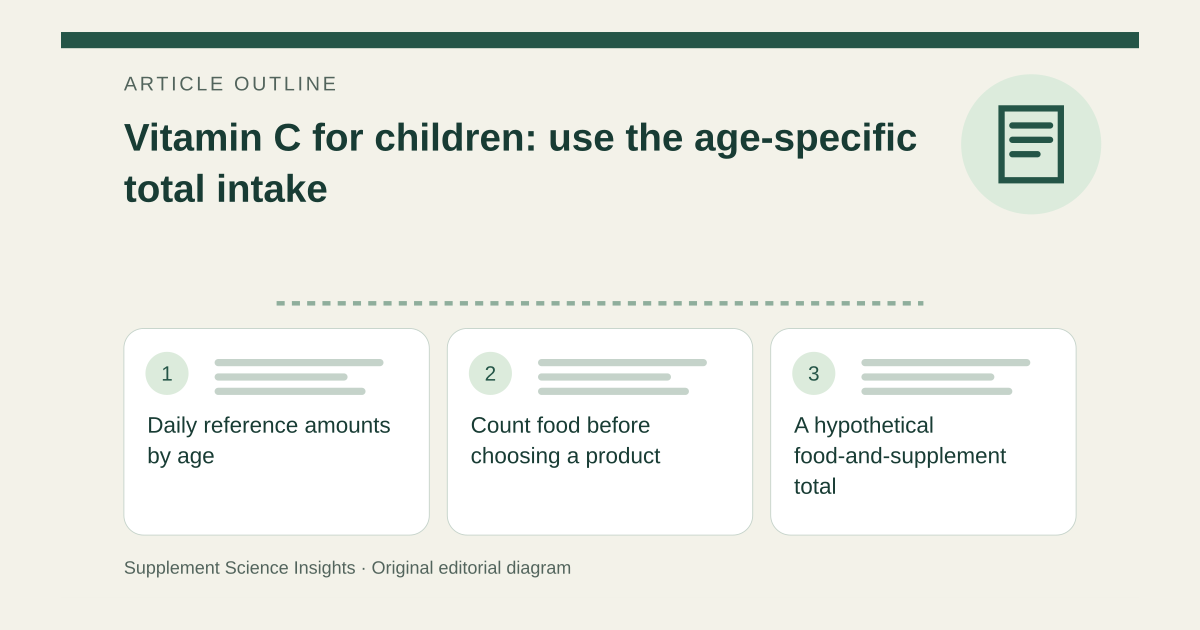
Daily reference amounts by age
NIH ODS gives vitamin C RDAs of 15 mg at ages 1–3, 25 mg at ages 4–8 and 45 mg at ages 9–13. At ages 14–18, the values are 75 mg for boys and 65 mg for girls; pregnancy and lactation have separate values. Infants use Adequate Intakes of 40 mg through six months and 50 mg at seven through twelve months, not directions to add that amount as a supplement. [1]
Count food before choosing a product
Fruit and vegetables can supply these amounts. A daily requirement does not diagnose deficiency, and taking extra does not automatically improve immunity. Excess vitamin C can cause diarrhea and abdominal discomfort. A child’s dietary restriction, illness or suspected deficiency merits an individual assessment rather than scaling down an adult megadose. [1]
A hypothetical food-and-supplement total
For a hypothetical eight-year-old whose recorded foods provide 30 mg, adding a 100 mg supplement makes 130 mg total. That calculation does not demonstrate a need for the supplement: the age-specific RDA is 25 mg. The RDA and the upper limit answer different questions, and neither is a target to exceed deliberately. [1]
| Age group | U.S. vitamin C RDA |
|---|---|
| 1–3 years | 15 mg/day |
| 4–8 years | 25 mg/day |
| 9–13 years | 45 mg/day |
Sources for this article
- Vitamin C - Health Professional Fact Sheet
Source consulted: 2026-09-20. This is a reference resource, not a claim that we conducted the studies or tested a product.