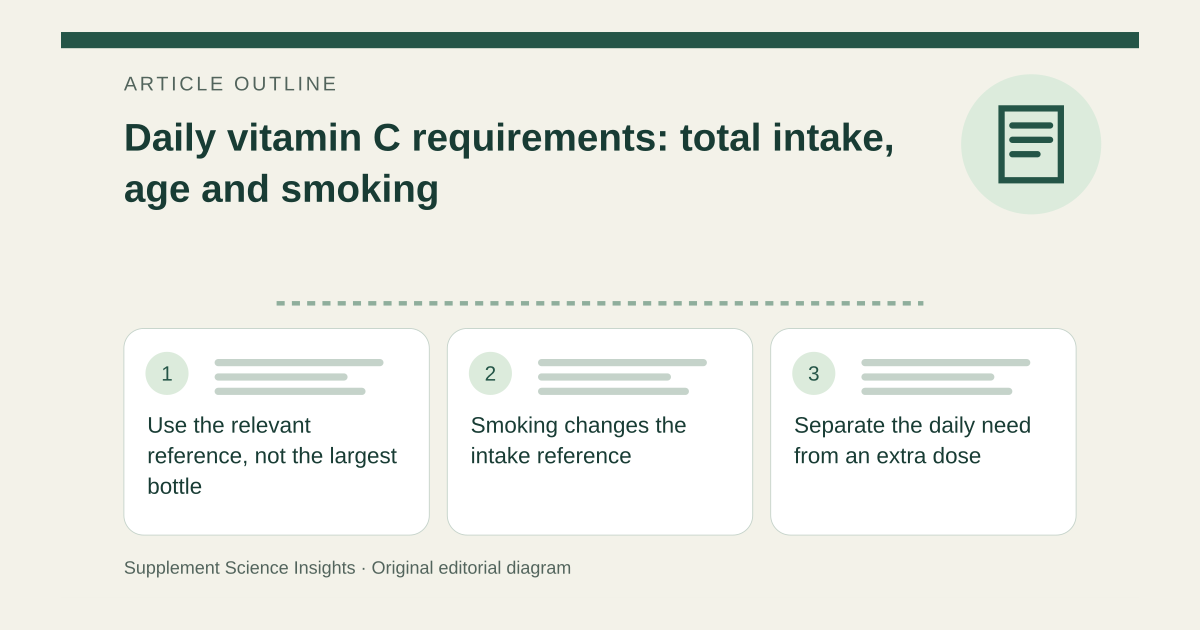
Use the relevant reference, not the largest bottle
The U.S. recommended dietary allowance for vitamin C is 90 mg per day for adult men and 75 mg for adult women outside pregnancy and breastfeeding. During adult pregnancy it is 85 mg, and during breastfeeding it is 120 mg. These are total-intake planning values for healthy people. [1]
Requirements differ in childhood: ODS lists 15 mg at ages 1–3, 25 mg at ages 4–8 and 45 mg at ages 9–13. Adolescent values differ again. An adult supplement amount should not be transferred to a child because the ingredient name is the same. [1]
Smoking changes the intake reference
People who smoke need an additional 35 mg of vitamin C daily according to the Food and Nutrition Board. This reflects, in part, greater oxidative stress. It is an adjustment to the intake reference, not evidence that supplements cancel the harms of smoking. [1]
Secondhand smoke exposure is also associated with lower vitamin C status, but the Board did not establish a separate numerical requirement for it. ODS advises ensuring the recommended intake rather than inventing another fixed increment. [1]
Separate the daily need from an extra dose
Imagine an adult woman obtains vitamin C from peppers, fruit and other foods, then sees a 75 mg reference. That number does not mean she needs another 75 mg in a tablet regardless of her meals.
The relevant comparison is her usual total intake and circumstances. One day’s incomplete food record is not enough to diagnose deficiency or select treatment.
| Detail | Meaning |
|---|---|
| Adult-woman RDA: 75 mg | Total intake, not an automatic tablet dose |
| Adult UL: 2,000 mg | Safety ceiling, not a nutritional goal |
| Smoking adjustment | Additional 35 mg in the reference intake |
Recommended intake and upper limit answer different questions
The adult upper limit is 2,000 mg per day from food and supplements. It is not a target or an amount needed to obtain vitamin C’s normal benefits. Younger age groups have lower ceilings. [1]
Digestive adverse effects can occur with high intake. Kidney disorders, iron-overload conditions and medical treatment warrant individualized advice instead of a calculation based only on the healthy-person reference. [1]
Sources for this article
- NIH ODS — Vitamin C: Health Professional Fact Sheet
Source consulted: 2026-09-17. This is a reference resource, not a claim that we conducted the studies or tested a product.