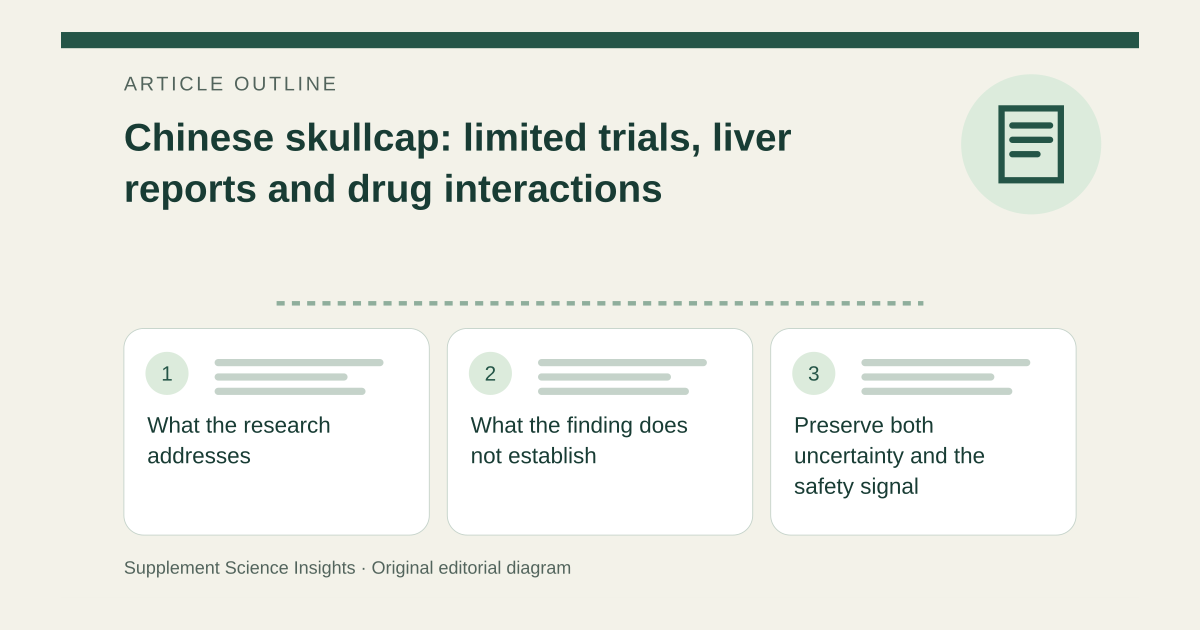
What the research addresses
Chinese skullcap, Scutellaria baicalensis, is used in traditional formulas and contains compounds such as baicalin. MSK describes limited human research. Findings for a formula or isolated constituent do not establish equivalent benefits from the herb alone. [1]
What the finding does not establish
Laboratory anticancer or anti-inflammatory effects are not clinical treatment results. A small study alongside another therapy also needs to be interpreted within that combination rather than as proof of an independent supplement effect. [1]
Preserve both uncertainty and the safety signal
Suppose liver injury occurs after a multi-ingredient product. The report may not identify which ingredient caused it, but that uncertainty does not make the product harmless. Record the full formulation and event instead of either blaming one ingredient with certainty or dismissing the report.
Apply the same standard to favorable findings. If the study used a blend, avoid assigning the improvement to skullcap alone. Consistent treatment of positive and negative evidence produces a more useful assessment than switching standards depending on whether a result supports a sale.
| Hypothetical finding or choice | What it means |
|---|---|
| A blend is linked to liver injury | A safety signal with attribution uncertainty |
| A blend improves a symptom | Cannot isolate skullcap's contribution |
| An isolated constituent changes drug levels | Relevant to a medication review |
Safety and treatment considerations
Liver injury has been reported with skullcap-containing formulas, and pneumonitis is described in the source. Baicalin reduced statin blood levels in a volunteer study. Other potential interactions, including with blood thinners, have uncertain clinical importance. Discuss use before combining it with medicines. [1]
A practical next step
No Chinese-skullcap product or dose is recommended. Bring the full label and medicine list into any discussion, and do not assume another plant sold under the common name skullcap has the same evidence or risks.
Sources for this article
- Memorial Sloan Kettering Cancer Center — Scutellaria baicalensis
Source consulted: 2026-09-17. This is a reference resource, not a claim that we conducted the studies or tested a product.