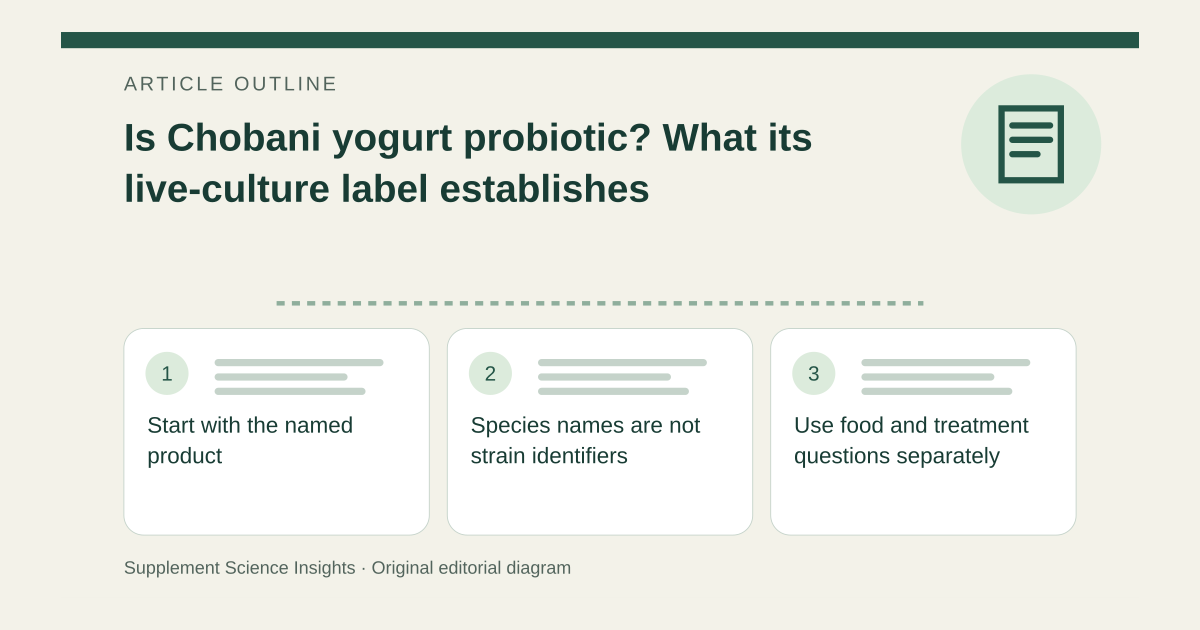
Start with the named product
Chobani’s consumer-care explanation identifies S. thermophilus and L. bulgaricus as the cultures that turn milk into Greek yogurt. Check the full culture list on your product; the brand sells different lines, and a general FAQ does not give every formulation’s strain codes or quantities. [1]
Species names are not strain identifiers
ODS distinguishes genus, species and strain, and explains why findings for one probiotic cannot automatically be applied to another. A label listing live cultures is useful, but it does not identify a proven dose for every digestive complaint. No specific CFU count should be invented from the word Greek. [2]
Use food and treatment questions separately
Imagine you want a yogurt to eat with breakfast and also have persistent digestive symptoms. Compare the yogurt’s protein, added sugar and tolerance as food. Evaluate the symptoms separately instead of assuming that any live-culture yogurt substitutes for a researched treatment. [3][2]
| Question | Useful check |
|---|---|
| Live-culture wording | Supports a culture-content claim |
| Strain and amount | Needed for a precise evidence comparison |
| Greek style | Does not state a probiotic dose |
Sources for this article
- What are live and active cultures?
Source consulted: 2026-09-20. This is a reference resource, not a claim that we conducted the studies or tested a product. - Probiotics - Health Professional Fact Sheet
Source consulted: 2026-09-20. This is a reference resource, not a claim that we conducted the studies or tested a product. - How to Understand and Use the Nutrition Facts Label | FDA
Source consulted: 2026-09-20. This is a reference resource, not a claim that we conducted the studies or tested a product.