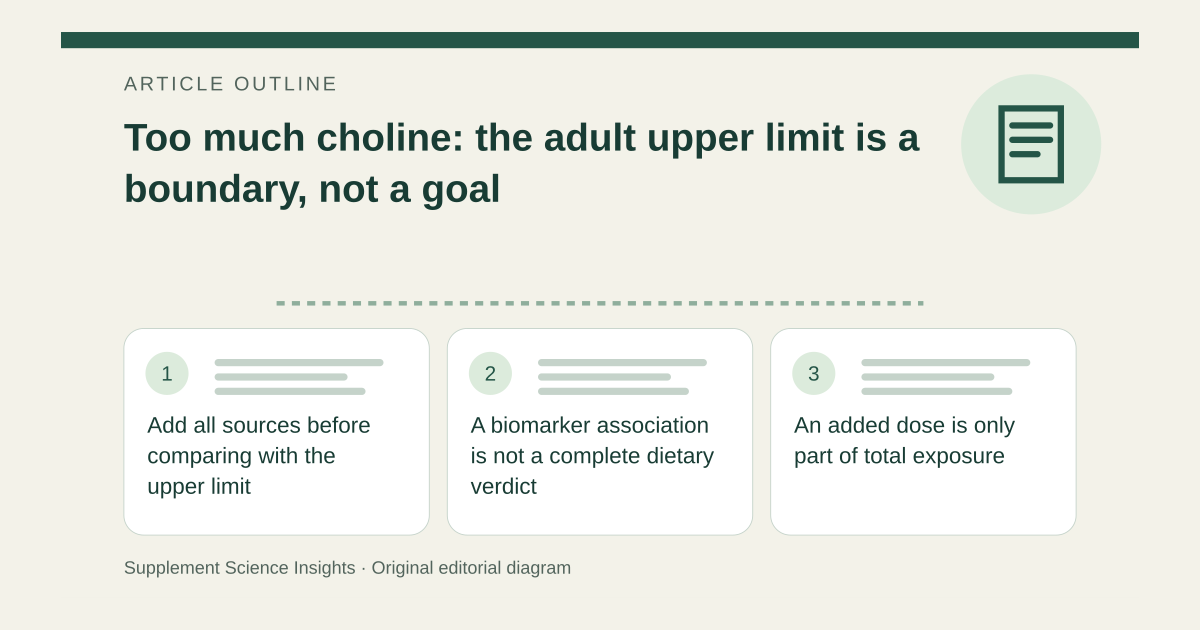
Add all sources before comparing with the upper limit
ODS lists an upper limit of 3,500 mg daily for adults, including during pregnancy and lactation. Lower limits apply to children and adolescents. The adult number is not a desirable daily target and is not a guarantee of safety for every person. [1]
High intakes have been associated with fishy body odor, vomiting, sweating, salivation, low blood pressure and liver toxicity. The limit was based principally on hypotension and fishy odor. Clinical use under supervision is a separate setting from self-selected high-dose supplementation. [1]
A biomarker association is not a complete dietary verdict
Gut bacteria can convert some choline to trimethylamine, which the liver converts to TMAO. Higher TMAO has been linked with cardiovascular risk, but the ODS review describes inconsistent associations between choline intake and cardiovascular outcomes. [1]
That uncertainty does not prove a supplement prevents heart disease, nor establish that ordinary choline-containing foods should be eliminated. Choline remains essential. Decisions should consider overall diet, actual exposure and clinical context rather than treating one biomarker as a complete benefit–risk assessment. [1]
An added dose is only part of total exposure
Imagine supplements provide 3,000 mg daily and food contributes another 600 mg. The total is 3,600 mg, above the adult UL. Comparing only the supplement amount with the limit would miss the food contribution.
| Item | Interpretation |
|---|---|
| Supplements | 3,000 mg |
| Food | 600 mg |
| Total | 3,600 mg, above the adult UL |
Sources for this article
- NIH ODS: Choline — Health Professional Fact Sheet
Source consulted: 2026-09-17. This is a reference resource, not a claim that we conducted the studies or tested a product.