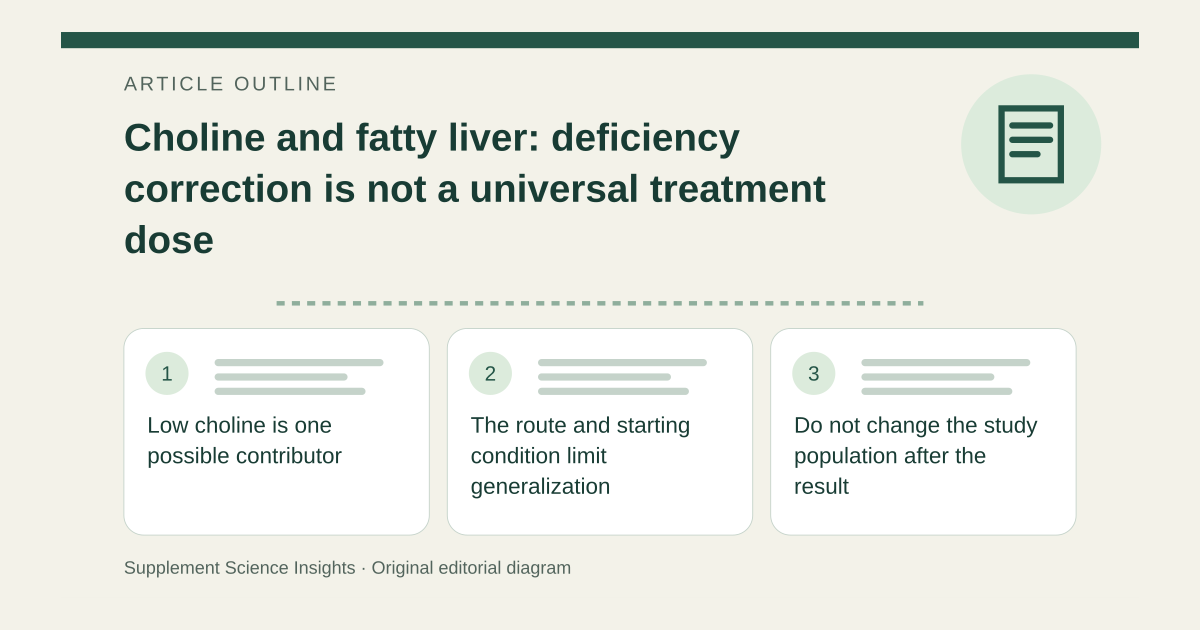
Low choline is one possible contributor
ODS explains that choline, especially as phosphatidylcholine, is needed for lipid transport from the liver. In deficiency, fat can accumulate and liver dysfunction can develop. This establishes a nutritional mechanism, but it does not show that every person with liver fat has choline deficiency. [1]
The cited fact sheet uses the older term nonalcoholic fatty liver disease. Its discussion includes observational associations and small studies in highly specific circumstances, rather than a universal oral-supplement treatment regimen. [1]
The route and starting condition limit generalization
One small pilot involved 15 adults receiving total parenteral nutrition, where nutrients are given intravenously. Another involved deliberate dietary choline restriction followed by repletion. Improvement after correcting a defined lack does not identify a capsule dose that reverses other causes of fatty liver. [1]
ODS concludes that more research is needed to clarify prevention and treatment roles. A liver-health assessment should establish the condition and contributing factors rather than presume deficiency from imaging alone. Excessive choline itself can cause adverse effects, so more is not automatically better. [1]
Do not change the study population after the result
Imagine a study corrects a nutritional shortfall during intravenous feeding. Applying its amount directly to a person eating an ordinary diet changes the route, baseline status and clinical setting. Those differences prevent a simple treatment-dose conversion.
| Item | Interpretation |
|---|---|
| Deficiency correction | A specific clinical setting |
| Other fatty-liver causes | Not automatically the same condition |
| Oral treatment dose | Not derived from intravenous exposure |
Sources for this article
- NIH ODS: Choline — Health Professional Fact Sheet
Source consulted: 2026-09-17. This is a reference resource, not a claim that we conducted the studies or tested a product.