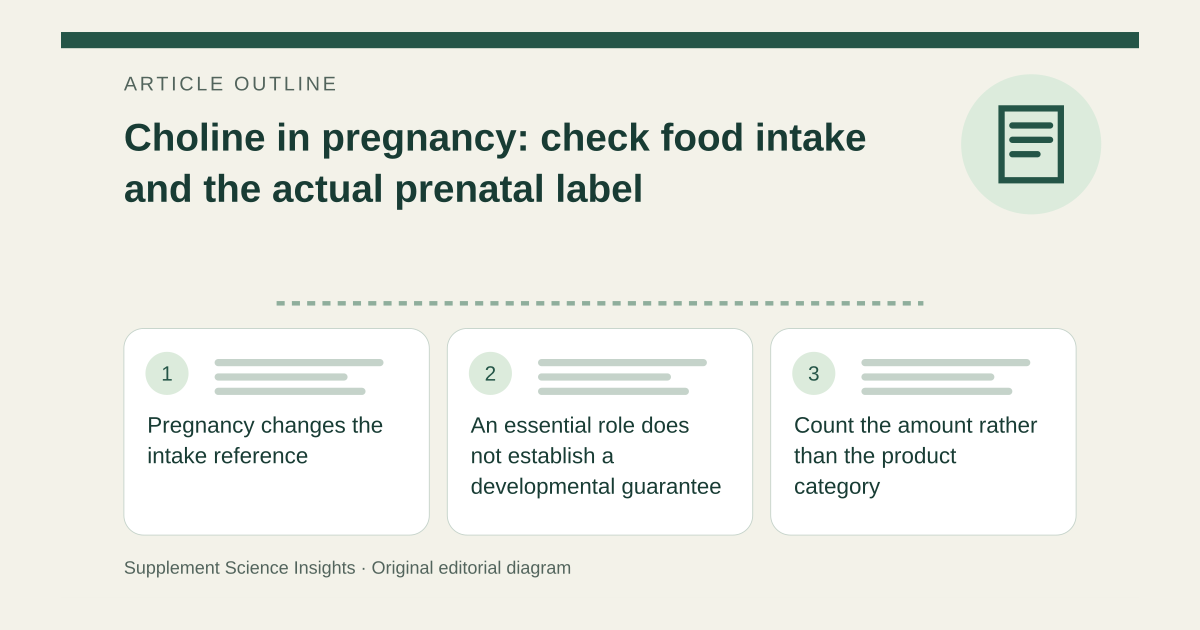
Pregnancy changes the intake reference
Choline participates in cell membranes, methyl-group metabolism and early brain development. ODS lists a pregnancy AI of 450 mg daily and a lactation AI of 550 mg. These are total-intake planning values, not automatic instructions to add those amounts in a supplement. [1]
ODS notes that prenatal products can contain little if any choline. The current label of the actual product is therefore more informative than the word prenatal. Include foods and other supplements when discussing intake with the maternity-care team. [1]
An essential role does not establish a developmental guarantee
Studies of maternal choline status and neural-tube-defect risk have produced inconsistent findings in the cited ODS review. A nutrient’s developmental role should not be rewritten as proof that a particular added dose prevents defects or increases a child’s intelligence. [1]
Choline also does not replace folate, vitamin B12 or other aspects of prenatal care. Related nutrient pathways can influence choline needs, but one nutrient cannot be assumed to cover another merely because their metabolic roles overlap. [1]
Count the amount rather than the product category
Imagine a prenatal label lists no choline while a food record contains several choline sources. Neither the product name nor the absent label line alone establishes total intake. The relevant assessment combines the diet with the product’s actual composition.
| Item | Interpretation |
|---|---|
| Pregnancy AI | 450 mg daily total |
| Prenatal product name | Does not establish choline content |
| Food plus supplements | The intake to assess |
Sources for this article
- NIH ODS: Choline — Health Professional Fact Sheet
Source consulted: 2026-09-17. This is a reference resource, not a claim that we conducted the studies or tested a product.