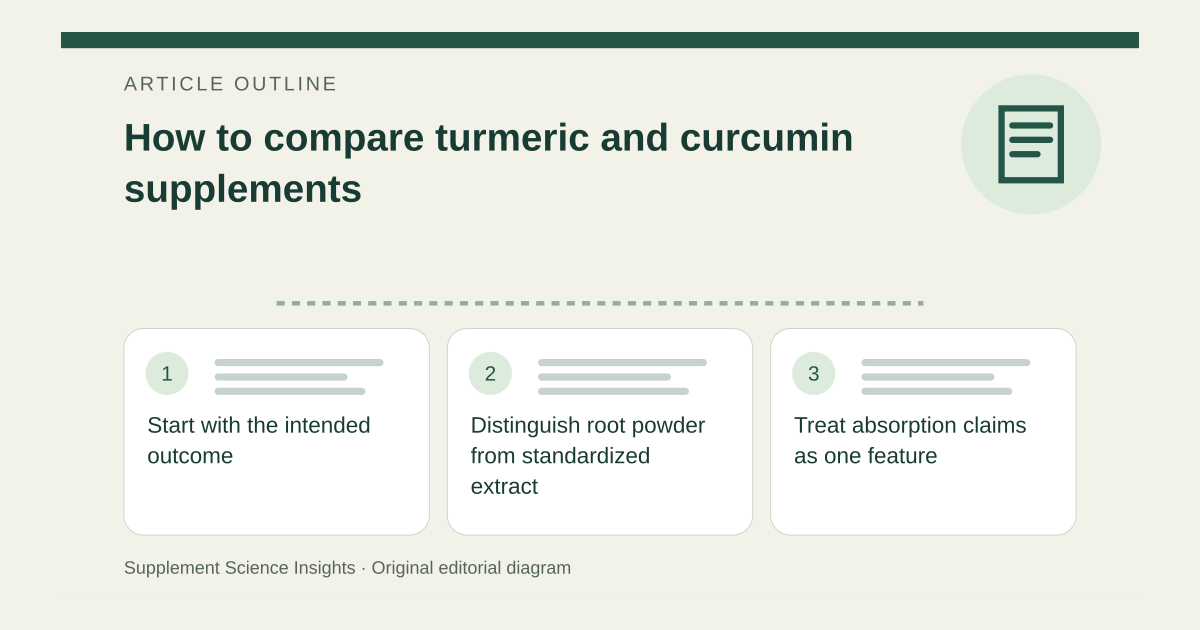
Start with the intended outcome
A product tested for one condition is not automatically useful for another. NCCIH describes promising but incomplete evidence for some uses and substantial uncertainty across promoted benefits. Identify the specific outcome you want to improve before comparing brands or doses. [1]
Distinguish root powder from standardized extract
Two labels can display the same weight while supplying different amounts of curcuminoids. Look for the actual ingredient, amount per serving and added substances, including piperine. Do not assume that turmeric weight and curcumin weight mean the same thing. [1][2]
Treat absorption claims as one feature
Enhanced formulations may increase exposure, but NCCIH reports liver-injury concerns with some of them. The EMA review separates high-dose or enhanced products from traditional preparations. More absorption is not sufficient evidence to rank a product as best. [1][2]
Quality verification and clinical benefit answer different questions
Independent quality testing can help check identity and contaminants. It does not prove that a supplement treats a disease or is suitable with every medicine. Prefer transparent ingredient amounts and verifiable testing rather than an unexplained quality badge or proprietary blend claim. [3]
Compare the complete decision rather than one number
Imagine one product has a larger powder dose while another has a lower-dose standardized extract plus piperine. They cannot be ranked from milligrams alone. Review formulation, relevant study evidence, quality information and the medicine list before deciding whether either is appropriate. [1][3]
| Feature | What to establish |
|---|---|
| Ingredient identity | Root powder, extract or other preparation |
| Serving amount | Actual curcuminoids when specified |
| Absorption enhancer | Added exposure and interaction considerations |
| Quality testing | Identity and contaminant checks |
| Clinical evidence | Relevant outcome with the same formulation |
Sources for this article
- Turmeric: Usefulness and Safety | NCCIH
Source consulted: 2026-09-21. This is a reference resource, not a claim that we conducted the studies or tested a product. - Addendum to assessment report on Curcuma longa L., rhizoma - published 2026
Source consulted: 2026-09-21. This is a reference resource, not a claim that we conducted the studies or tested a product. - Dietary Supplements: What You Need to Know
Source consulted: 2026-09-21. This is a reference resource, not a claim that we conducted the studies or tested a product.