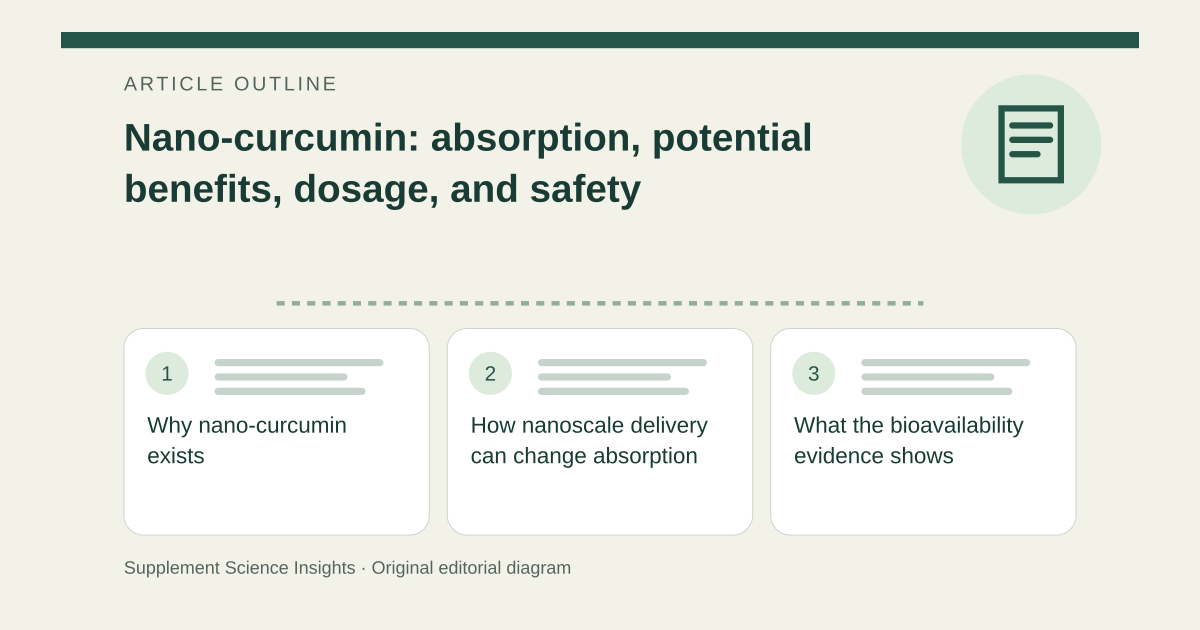
Why nano-curcumin exists
Curcumin is a yellow polyphenol found in turmeric (Curcuma longa) and is widely studied for anti-inflammatory and antioxidant activity. The central problem with ordinary oral curcumin is not a lack of biological activity in laboratory systems; it is getting enough intact compound into systemic circulation after ingestion. [1][2][4]
Standard curcumin has low water solubility, limited absorption from the gastrointestinal tract, extensive metabolism, and relatively rapid elimination. Together, these factors can produce low circulating concentrations even when gram-scale amounts are consumed. Nanoformulations were developed as one strategy to improve dissolution, protect curcumin during transit, and increase exposure after oral dosing. [1][2][4]
How nanoscale delivery can change absorption
The term nano-curcumin does not identify one standardized ingredient. It can describe nanomicelles, polymeric nanoparticles, nanocrystals, liposomes or other nanovesicles, solid-lipid nanoparticles, nanoemulsions, nanosuspensions, and related carrier systems. Some approaches reduce particle size directly, while others encapsulate curcumin inside a carrier that improves its behavior in an aqueous environment. [2][4]
Smaller particles can increase surface area available for dissolution. Carrier systems may also shield curcumin from degradation, improve dispersion in gastrointestinal fluids, or change how the compound interacts with intestinal membranes. The exact mechanism depends on the formulation, which is why two products labeled “nano-curcumin” should not automatically be treated as pharmacologically equivalent. [2][4]
What the bioavailability evidence shows
Systematic reviews of nanoparticle and nanoformulated curcumin generally report greater oral bioavailability or systemic exposure than free curcumin in the formulations that have been studied. Pharmacokinetic studies may compare measures such as peak blood concentration, time to peak concentration, or area under the concentration-time curve. [2]
That is an important formulation result, but it answers a pharmacokinetic question rather than a clinical one. A formulation can produce higher blood concentrations without proving that it improves pain, inflammation, cardiovascular outcomes, cognition, or any other health endpoint. Claims about efficacy therefore need trials that measure the outcome of interest, not only absorption. [2]
Potential health uses and the limits of the evidence
Nano-curcumin has been studied in clinical trials across inflammatory, metabolic, musculoskeletal, cardiovascular, and other conditions. Individual studies have reported changes in inflammatory markers, symptoms, or metabolic measurements, but the literature is heterogeneous: diseases, delivery systems, doses, trial durations, sample sizes, and endpoints vary considerably. [3][1][4]
This variability makes it difficult to treat nano-curcumin as a single intervention. A result obtained with one proprietary nanomicelle or nanoparticle system may not apply to a different carrier. NCCIH similarly concludes that evidence for turmeric and curcumin overall is not sufficient to establish definitive benefit for most health purposes. The most useful interpretation is therefore condition-specific and formulation-specific rather than a broad claim that nano-curcumin is clinically “more potent.” [3][1][4]
The same caution applies to neurological claims. Some nanoscale delivery systems are investigated for their ability to alter tissue distribution or improve transport, but demonstrating transport in experimental systems is not equivalent to demonstrating a meaningful cognitive or neuroprotective benefit in humans. [3][1][4]
Dosage cannot be reduced to one nano-curcumin number
Clinical studies have used doses far below the gram-scale amounts often associated with conventional curcumin, but there is no universal conversion factor between standard curcumin and every nanoformulation. The delivered exposure depends on the carrier, curcuminoid content, manufacturing method, and pharmacokinetics of the specific product. [3][2]
For that reason, an effective dose reported for one studied formulation should not be automatically transferred to another. When reviewing a trial or product, record the actual curcumin dose, delivery technology, dosing frequency, duration, comparator, and whether the commercial product is the same formulation used in the cited research. [3][2]
Safety and interactions still matter when absorption improves
Curcumin products are often tolerated without serious problems, but gastrointestinal symptoms such as nausea, diarrhea, or abdominal discomfort can occur. Increasing bioavailability can also alter exposure, so improved absorption should not be assumed to be an unqualified safety advantage. [1]
NCCIH has reported cases of liver injury associated with some highly bioavailable curcumin products. Curcumin and turmeric supplements may also be relevant to people using anticoagulant or antiplatelet drugs or other medicines, although the importance of a specific interaction depends on the product and clinical context. NCCIH advises that turmeric supplements during pregnancy may be unsafe at amounts above those normally found in food. People with medical conditions or medication regimens should therefore review concentrated curcumin supplementation with a clinician. [1]
How to judge a nano-curcumin product or study
A label that says “nano” is not enough to establish quality. Useful details include the delivery system, curcuminoid content, dose per serving, carrier or excipient system, and whether the marketed product is linked to human pharmacokinetic or clinical data. Independent testing can help verify identity, purity, and contaminant limits, but it does not itself prove clinical efficacy. [2][3][1]
For research comparison, capture particle or carrier characteristics when reported, the exact formulation, curcumin dose, comparator, pharmacokinetic measures, clinical endpoints, adverse events, funding, and conflicts of interest. This makes it possible to distinguish a credible formulation-specific result from a generalized marketing claim. [2][3][1]
We may earn a commission when you buy through Amazon links on this page. Disclosure.
Sources for this article
- NCCIH — Turmeric: Usefulness and Safety
Source consulted: 2026-09-16. This is a reference resource, not a claim that we conducted the studies or tested a product. - Pharmacokinetics of Curcumin Delivered by Nanoparticles: A Systematic Review
Source consulted: 2026-09-16. This is a reference resource, not a claim that we conducted the studies or tested a product. - Effect of nano-curcumin on various diseases: A comprehensive review of clinical trials
Source consulted: 2026-09-16. This is a reference resource, not a claim that we conducted the studies or tested a product. - Enhancing Curcumin Oral Bioavailability Through Nanoformulations
Source consulted: 2026-09-16. This is a reference resource, not a claim that we conducted the studies or tested a product. - ScienceInsights — What Is Nano Curcumin and How Does It Work?
Source consulted: 2026-09-16. This is a reference resource, not a claim that we conducted the studies or tested a product.
Considering a supplement?
Ingredient evidence alone does not establish which retail product is suitable. The featured option illustrates the label and formulation context above; it is not a clinical efficacy ranking.
A narrowly scoped colloidal formulation option is presented after the article’s product-evaluation context, with limitations and three-form comparison.
Compare three curcumin formulations → No overall winner
Integrative Therapeutics Theracurmin HP: product dossier
Life Extension Curcumin Elite: product dossier
Nature Made Turmeric Curcumin 500 mg: product dossier
Compare formulations → · How we select products