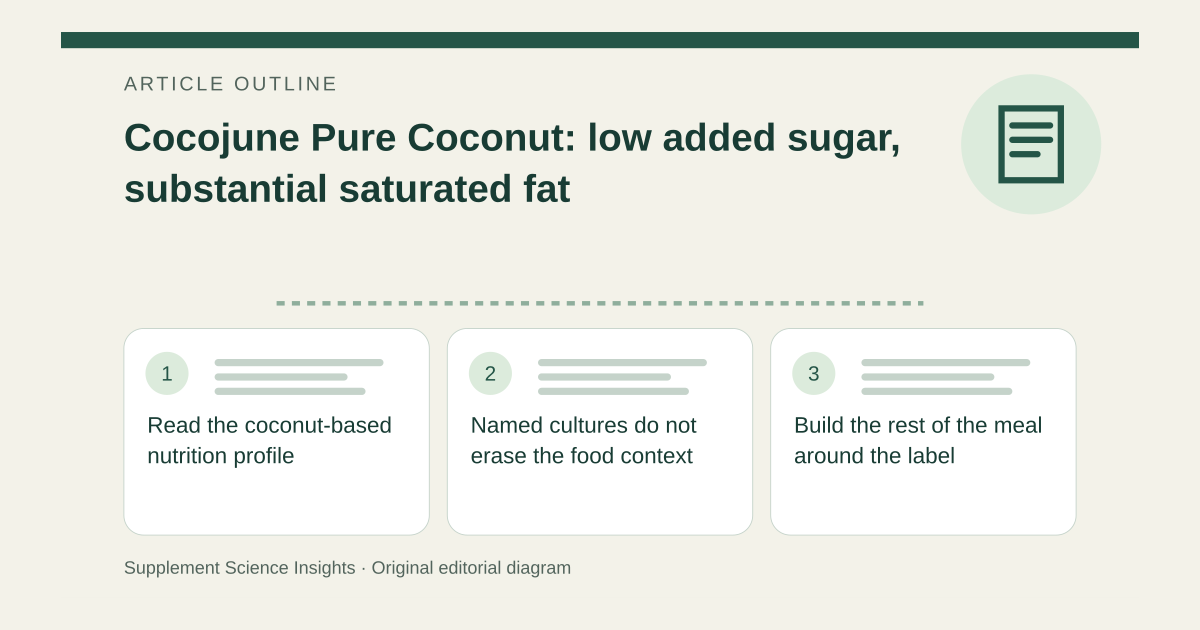
Read the coconut-based nutrition profile
The manufacturer’s 4oz Pure Coconut serving lists 180calories,18g total fat,15g saturated fat and 2g protein, with 0g added sugars. That is useful detail: no added sugar does not mean a low-fat or high-protein food. Check the current container for changes. [1]
Named cultures do not erase the food context
The page lists cultures including Bifidobacterium lactis BB-12 and L. acidophilus LA-5. Naming strains is more specific than a generic culture claim, but the product list alone does not establish an effective dose for a particular condition. Its calcium and protein content also should not be assumed equal to milk yogurt. [1][2]
Build the rest of the meal around the label
Imagine choosing it because you avoid dairy. You could account for its 2g protein separately from another protein food, and compare saturated fat with your overall eating pattern. FDA explains that daily-value percentages help put nutrients such as saturated fat in context; the dairy-free label is not the whole assessment. [1][3]
| Question | Useful check |
|---|---|
| Dairy-free preference | Check the coconut recipe |
| Protein contribution | Use labeled grams |
| No added sugar | Still review saturated fat and portion |
Sources for this article
- Pure Coconut | Cocojune : Cocojune
Source consulted: 2026-09-20. This is a reference resource, not a claim that we conducted the studies or tested a product. - Probiotics - Health Professional Fact Sheet
Source consulted: 2026-09-20. This is a reference resource, not a claim that we conducted the studies or tested a product. - How to Understand and Use the Nutrition Facts Label | FDA
Source consulted: 2026-09-20. This is a reference resource, not a claim that we conducted the studies or tested a product.