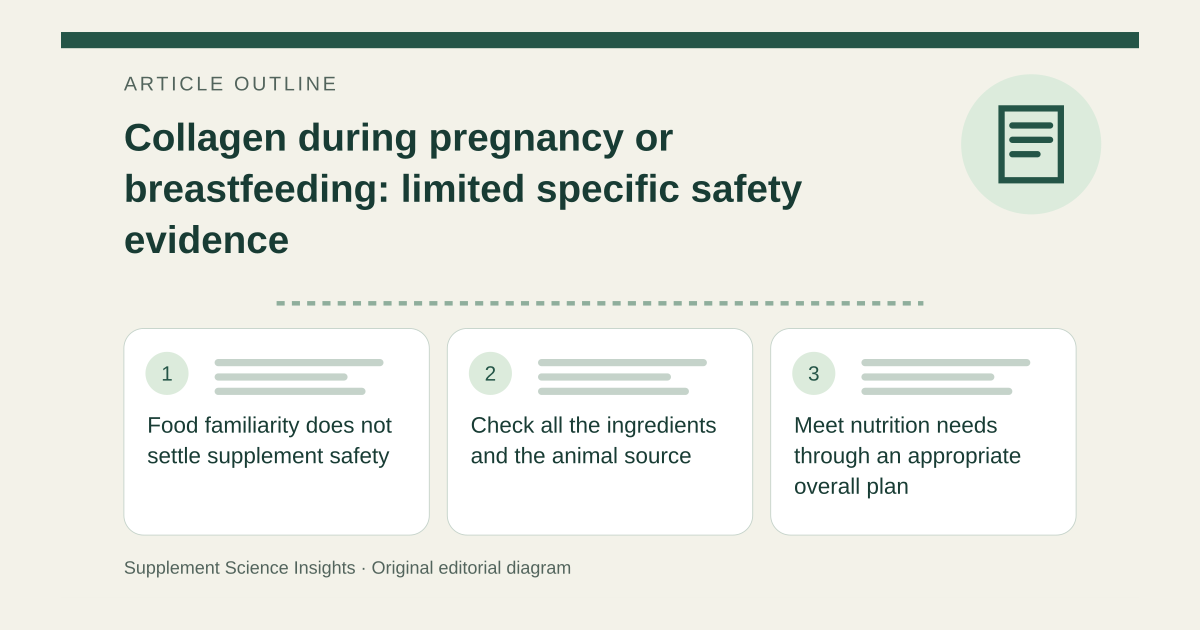
Food familiarity does not settle supplement safety
Collagen is a protein found in animal tissues, but a concentrated powder or beauty blend is a formulated product. MSK’s summary does not provide dedicated pregnancy or breastfeeding safety evidence for every preparation. NIH recommends caution with supplements beyond the usual prenatal plan because many lack adequate testing in these groups. [1][2]
Check all the ingredients and the animal source
Read the full label for vitamins, herbs, stimulants, flavorings and the collagen source. A plain product and a multi-ingredient blend cannot share an automatic safety conclusion. Quality testing may help assess contents, but it does not establish fetal or infant safety or prove a benefit. [2]
Meet nutrition needs through an appropriate overall plan
A varied diet supplies protein and other nutrients. During breastfeeding, CDC recommends individualized attention to increased nutritional needs, including iodine and choline, and supplements when appropriate. A collagen product does not replace the prenatal or postpartum nutrients recommended for a particular person. [3][4]
Breastfeeding benefits are not established by skin claims
Research on skin appearance or joint symptoms does not demonstrate increased milk supply, improved infant nutrition or faster postpartum recovery. The inspected collagen summary does not establish those outcomes. Discuss a defined concern, such as low intake or another symptom, instead of assuming a postpartum label validates the product. [1][4]
If already used, review the product rather than assuming harm
Imagine someone learns they are pregnant after using a collagen blend. Save the label, amount and dates and discuss them with the maternity team. Limited safety evidence is not proof that harm occurred; the review should focus on the actual ingredients and exposure. [2]
| Question | Reason |
|---|---|
| What is in it? | Formulas differ |
| Why is it needed? | Separate nutrition needs from beauty claims |
| Does it duplicate a prenatal? | Avoid unnecessary excess |
| Already taken? | Review actual exposure with the care team |
Sources for this article
- Collagen | Memorial Sloan Kettering Cancer Center
Source consulted: 2026-09-21. This is a reference resource, not a claim that we conducted the studies or tested a product. - Dietary Supplements: What You Need to Know
Source consulted: 2026-09-21. This is a reference resource, not a claim that we conducted the studies or tested a product. - Eating a balanced diet - NHS
Source consulted: 2026-09-21. This is a reference resource, not a claim that we conducted the studies or tested a product. - Maternal Diet and Breastfeeding | Breastfeeding special circumstances | CDC
Source consulted: 2026-09-21. This is a reference resource, not a claim that we conducted the studies or tested a product.