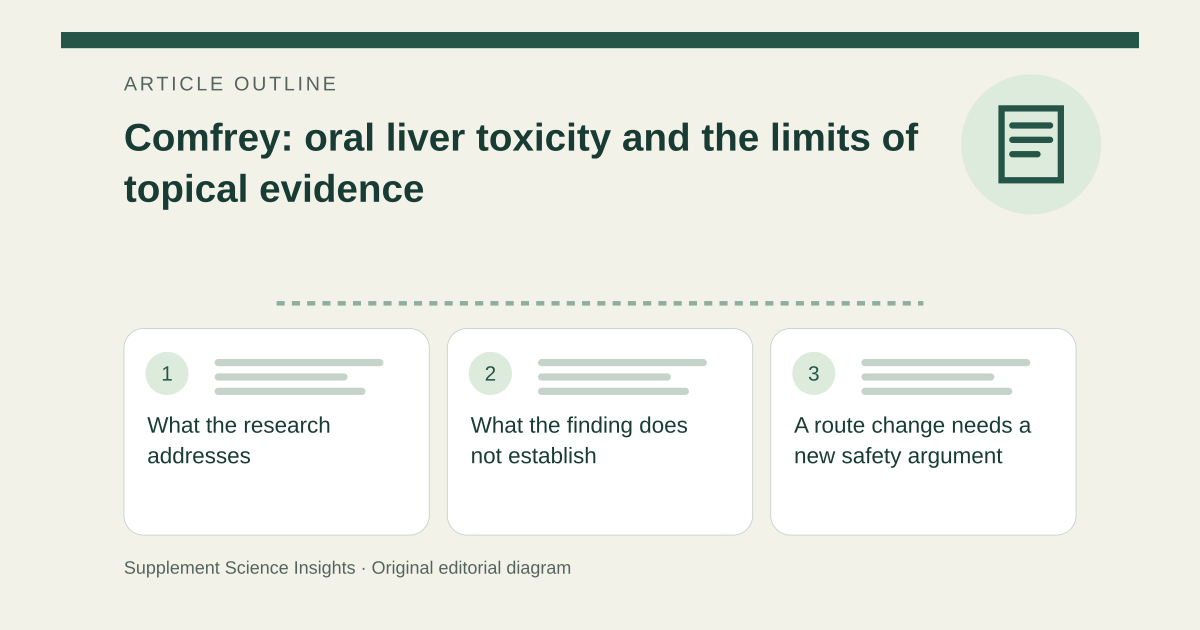
What the research addresses
Comfrey leaves and roots have a history of use for wounds and pain. MSK describes limited research on topical preparations. Those findings do not establish that swallowing comfrey provides a useful benefit. [1]
What the finding does not establish
Comfrey contains pyrrolizidine alkaloids that can damage the liver. Changing the route from a studied topical preparation to a tea or capsule is a major change in exposure, not a harmless substitution. [1]
A route change needs a new safety argument
Imagine a person sees a study of a manufactured topical preparation and decides to make an oral tea from the plant. The study did not evaluate that tea, its composition or swallowing it. The evidence cannot be stretched to cover the new exposure simply because the source plant is shared.
Product processing matters too. Evidence about a defined formulation should stay attached to that formulation. It cannot serve as a safety assurance for an unidentified leaf, a homemade extract or another commercial product. This is especially important when the plant contains compounds with established toxicity.
| Hypothetical finding or choice | What it means |
|---|---|
| A manufactured topical formulation | Evidence limited to that intervention |
| A homemade tea | A different and hazardous oral exposure |
| A visually identified plant | Identity errors can add a separate poisoning risk |
Safety and treatment considerations
Do not ingest comfrey as a remedy. Liver toxicity from oral use is documented. MSK also records dangerous confusion with foxglove when plants were gathered for tea. A familiar plant name or home-grown source does not establish either identity or safety. [1]
A practical next step
This article gives no preparation instructions or dose for comfrey. Discuss suitable alternatives for pain or wound care rather than interpreting limited topical research as permission for self-directed oral use.
Sources for this article
- Memorial Sloan Kettering Cancer Center — Comfrey
Source consulted: 2026-09-17. This is a reference resource, not a claim that we conducted the studies or tested a product.