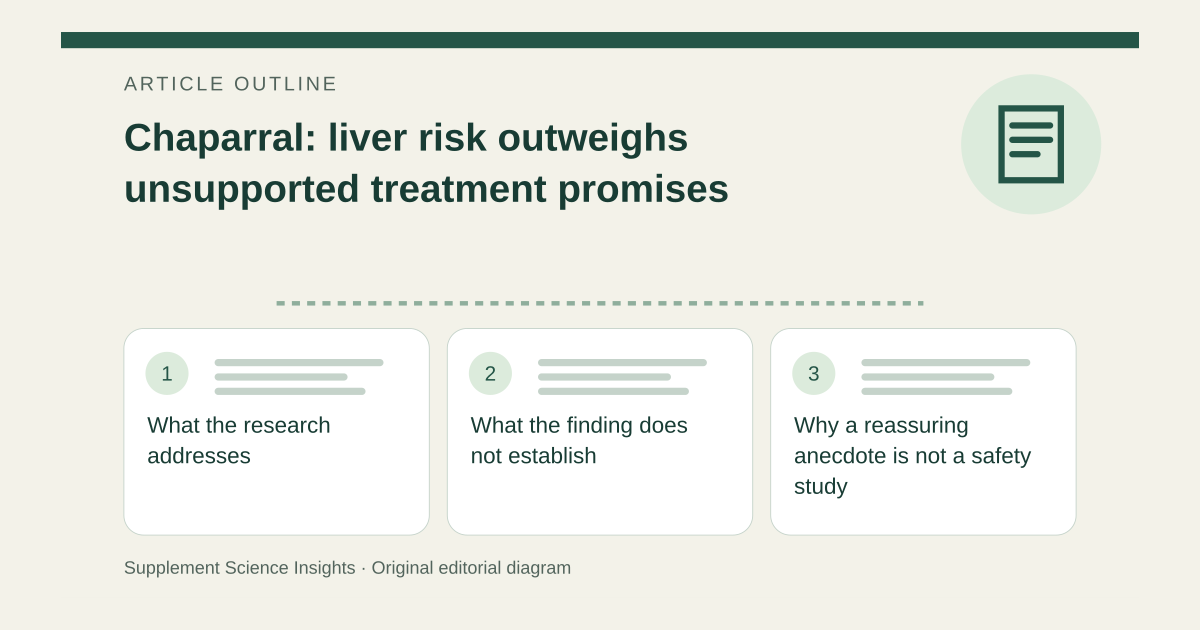
What the research addresses
Chaparral is a desert plant traditionally used in teas and other remedies. MSK describes severe liver injury associated with chaparral-containing products, including cases requiring transplantation. Laboratory research on its constituent NDGA does not establish that taking chaparral is an effective treatment. [1]
What the finding does not establish
MSK reports that a clinical cancer study found chaparral ineffective. Findings about an isolated compound, an animal model or a topical preparation do not establish a useful role for an oral tea or capsule. [1]
Why a reassuring anecdote is not a safety study
Imagine a seller points to several people who drank a tea and felt fine. That observation cannot rule out an uncommon but severe adverse effect. To estimate risk, we would need to know how many people used a defined preparation, for how long, and how systematically harms were assessed.
The same reasoning applies to “used for centuries.” The phrase describes a history of use, not a count of monitored exposures or a reliable estimate of liver injury. When the proposed benefit is unproven and serious harm is documented, absence of a precise risk percentage is not a reason to assume safety.
| Hypothetical finding or choice | What it means |
|---|---|
| Several users report no symptoms | Cannot exclude uncommon severe injury |
| Laboratory activity of NDGA | Does not establish oral chaparral benefit |
| Traditional use | Does not quantify a safe dose or duration |
Safety and treatment considerations
Do not use chaparral as a self-directed treatment. Its liver-injury reports include irreversible harm. A small report without observed adverse effects cannot define a safe exposure or cancel the serious reports; the relation between exposure length and risk remains uncertain. [1]
A practical next step
This article provides no chaparral dose or product recommendation. If you already use it, tell your clinician the preparation, amount and duration rather than relying on a detox or antioxidant claim.
Sources for this article
- Memorial Sloan Kettering Cancer Center — Chaparral
Source consulted: 2026-09-17. This is a reference resource, not a claim that we conducted the studies or tested a product.