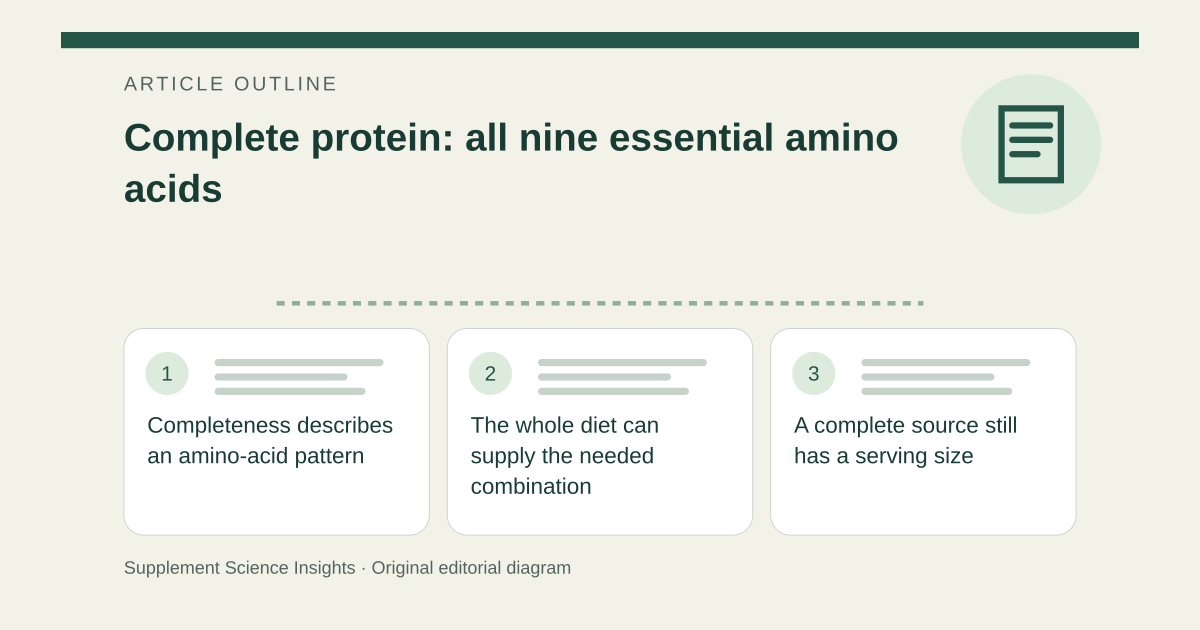
Completeness describes an amino-acid pattern
The nine essential amino acids are histidine, isoleucine, leucine, lysine, methionine, phenylalanine, threonine, tryptophan and valine. They must be obtained through the diet because the body cannot supply the needed amounts on its own. [1][2]
ODS describes complete proteins as supplying all nine. Examples in its discussion include milk proteins. Complete does not mean a serving contains every vitamin, enough energy or the entire day’s protein requirement. [1][2]
The whole diet can supply the needed combination
A diet can obtain essential amino acids from several foods rather than from a single powder. MedlinePlus says animal foods are not required to meet protein needs and that the balance across the day matters more than obtaining every essential amino acid at every meal. [1][2]
This is why a comparison of isolated ingredients cannot replace an assessment of the amount and variety actually eaten. Protein quality and total quantity are related but distinct questions. [1][2]
A complete source still has a serving size
Imagine a small serving of a complete protein supplies only a few grams of protein. Its amino-acid pattern does not turn those few grams into a full day’s intake.
Conversely, a day containing complementary plant foods should be assessed as that combined diet rather than judged solely from one ingredient eaten at one meal.
| Detail | Meaning |
|---|---|
| All nine essential amino acids | Completeness |
| Grams in the serving | Quantity |
| Every nutrient needed in a day | Not implied by complete protein |
Do not confuse BCAAs with the full set
Leucine, isoleucine and valine are only three of the nine essential amino acids. A BCAA-only product therefore does not supply the complete set, even if its advertised ratio is prominent. [2]
The term complete is a useful composition description, not evidence of a product’s superiority or a personal need for an isolated amino-acid supplement. [2]
Sources for this article
- MedlinePlus: Protein in diet
Source consulted: 2026-09-17. This is a reference resource, not a claim that we conducted the studies or tested a product. - NIH ODS: Dietary Supplements for Exercise and Athletic Performance
Source consulted: 2026-09-17. This is a reference resource, not a claim that we conducted the studies or tested a product.