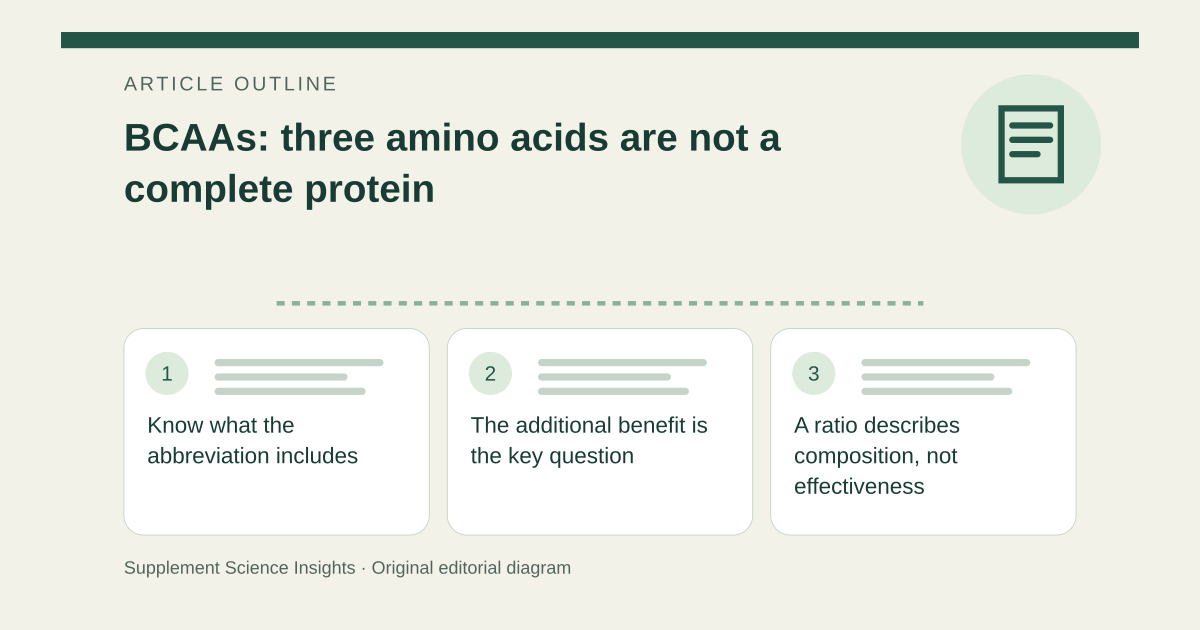
Know what the abbreviation includes
Branched-chain refers to the shape of these amino acids’ side chains. Skeletal muscle can metabolize BCAAs for energy, and leucine also participates in signals involved in muscle protein synthesis. A signal to build protein still needs the other necessary amino acids as material; it is not evidence that a BCAA-only formula replaces a complete protein or improves every training outcome. [1]
BCAAs are leucine, isoleucine and valine, three of the nine essential amino acids. They occur naturally in protein-containing foods and are also sold as isolated powders or drinks. A complete protein provides the full set of essential amino acids; a BCAA-only product does not. [1]
The body uses these amino acids in normal metabolism and muscle tissue. Their biological importance does not establish a need to buy them separately from food or other protein sources. [1]
The additional benefit is the key question
The NIH Office of Dietary Supplements reports inconsistent evidence that supplemental BCAAs improve exercise performance, muscle gain or recovery. Research has not consistently shown an advantage beyond consuming sufficient high-quality protein. Some short training studies suggest benefits, but the overall findings do not support a blanket promise. [1]
A study in someone with inadequate protein intake is not equivalent to a study testing extra BCAAs on top of an adequate diet. Similarly, a change in perceived soreness or a laboratory marker should not be relabeled as proof of greater muscle growth or faster race times. [1]
A ratio describes composition, not effectiveness
A common label presents a leucine:isoleucine:valine ratio. This identifies relative amounts, provided the total BCAA quantity is also disclosed. It does not tell you the other six essential amino acids are present, nor does a larger first number prove a better result.
When comparing formulas, first establish whether the stated grams refer to BCAAs alone or a larger flavored blend. A ratio without an absolute amount cannot tell you how much of any amino acid is in a serving.
Keep study populations attached to safety claims
The ODS fact sheet describes tolerability findings from supplemental BCAA research, but those findings should not be converted into a universal daily target. Healthy-adult sports studies are not a safety assessment for every child, pregnancy or medical condition. [1]
Check multi-ingredient formulas separately for stimulants and other active ingredients. Evidence about three amino acids does not establish the safety of everything packaged with them. A prescribed dietary plan should take priority over a general gym supplement claim. [1]
Read a hypothetical 2:1:1 label
A product disclosing six grams of BCAAs at a 2:1:1 ratio has four total parts. Each part is 1.5 grams, giving three grams of leucine and 1.5 grams each of isoleucine and valine.
This is a composition calculation, not a recommendation. It neither supplies the missing essential amino acids nor demonstrates that the mixture adds value beyond an adequate protein intake. For any advertised recovery benefit, also ask whether researchers measured symptoms, function or a blood marker, and over what period.
| Amino acid | Parts | Amount in 6 g |
|---|---|---|
| Leucine | 2 | 3 g |
| Isoleucine | 1 | 1.5 g |
| Valine | 1 | 1.5 g |
Sources for this article
- NIH ODS — Exercise and Athletic Performance, professional fact sheet
Source consulted: 2026-09-17. This is a reference resource, not a claim that we conducted the studies or tested a product.