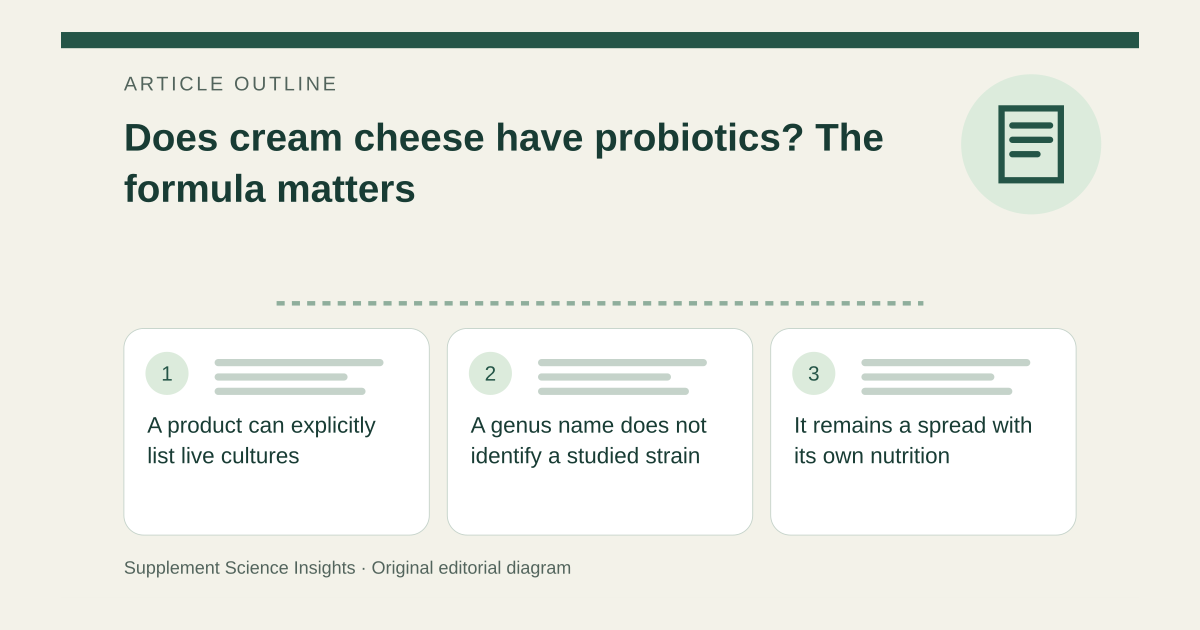
A product can explicitly list live cultures
Good Culture’s Plain 7 oz cream-cheese spread lists cream, nonfat milk, sea salt and live Bifidobacterium cultures. The manufacturer markets it as containing probiotics. This is a formulation example, not evidence that ordinary cream cheese or every competing spread has the same organisms. [1]
A genus name does not identify a studied strain
The listing uses Bifidobacterium spp. rather than a complete strain designation. ODS explains why organism identity, adequate live amount and evidence of benefit matter. A marketing category alone does not establish that the spread can replace a preparation studied for a particular condition. [2][1]
It remains a spread with its own nutrition
The inspected page lists 80 calories, 8 g fat and 1 g protein per two-tablespoon serving. Do not assume the nutrition resembles a high-protein cultured dairy food merely because both mention live cultures. Check the package in hand because formulas and serving definitions can change. [1]
Compare the purpose, not just the culture wording
Imagine choosing between a cream-cheese spread for a bagel and a protein-rich dairy food for a meal. Their portions and nutrient contributions differ. If the goal is relief of a digestive condition, seek evidence for the actual preparation instead of choosing solely from a probiotic badge. [1][2]
| Goal | Useful information |
|---|---|
| Spread for a meal | Taste, portion and nutrient label |
| Specific digestive outcome | Strain, viable amount and relevant evidence |
Sources for this article
- Plain Cream Cheese, 7 oz - Good Culture
Source consulted: 2026-09-20. This is a reference resource, not a claim that we conducted the studies or tested a product. - Probiotics - Health Professional Fact Sheet
Source consulted: 2026-09-20. This is a reference resource, not a claim that we conducted the studies or tested a product.