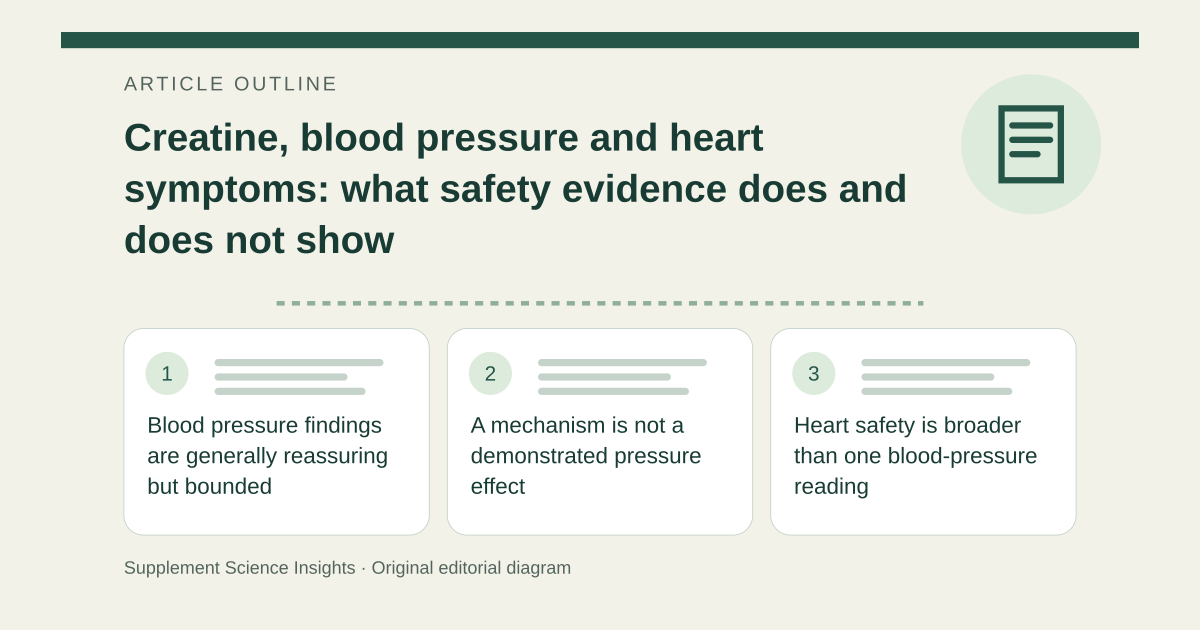
Blood pressure findings are generally reassuring but bounded
A 2025 narrative review reports no adverse blood-pressure effect in the short-term studies it summarizes or in a longer study of postmenopausal women. It also notes a lack of studies specifically enrolling people who were hypertensive at baseline. These findings do not establish creatine as treatment for hypertension. [1]
A mechanism is not a demonstrated pressure effect
The review distinguishes circulating creatine kinase, an enzyme associated with several physiological processes, from the amount of creatine supplied by a supplement. Associations involving an enzyme or a theory about water retention cannot alone prove that taking creatine raises blood pressure. [1]
Heart safety is broader than one blood-pressure reading
A normal pressure result does not assess every heart rhythm or establish safety with every cardiac condition and medicine. Creatine’s sports-performance evidence should not be used to replace cardiovascular care. The review disclosed multiple industry relationships and reported no funding for the work. [2][1]
Palpitations do not identify the ingredient responsible
The inspected sources do not establish pure creatine as a predictable cause of palpitations. Caffeine, strenuous exercise, sleep loss, stress, medicines and medical conditions are recognized contributors. Check whether the product is a stimulant-containing blend and record when the symptoms occur. [3][4][2]
Act on symptoms rather than a reassurance claim
Palpitations that persist or occur with chest pain, breathlessness or faintness need emergency assessment. Recurring episodes, episodes lasting more than a few minutes or symptoms in someone with a heart condition also need clinical review. An ECG or other assessment may be appropriate. [3]
Make the product and symptom history specific
Imagine a person with treated hypertension develops a racing heartbeat after a caffeinated pre-workout containing creatine. Bring the full label, medicines and symptom timeline to the clinician. Do not assume creatine is responsible or that moving the scoop to another time makes the episode safe. [3][4]
| Observation | Appropriate interpretation |
|---|---|
| No pressure rise in a study | Limited to its population and protocol |
| Caffeinated blend | Assess all ingredients |
| Recurring palpitations | Clinical review |
| Chest pain or faintness | Emergency assessment |
Sources for this article
- Part II. Common questions and misconceptions about creatine supplementation: what does the scientific evidence really show? - PMC
Source consulted: 2026-09-21. This is a reference resource, not a claim that we conducted the studies or tested a product. - Dietary Supplements for Exercise and Athletic Performance - Health Professional Fact Sheet
Source consulted: 2026-09-21. This is a reference resource, not a claim that we conducted the studies or tested a product. - Heart palpitations - NHS
Source consulted: 2026-09-21. This is a reference resource, not a claim that we conducted the studies or tested a product. - Spilling the Beans: How Much Caffeine is Too Much? | FDA
Source consulted: 2026-09-21. This is a reference resource, not a claim that we conducted the studies or tested a product.