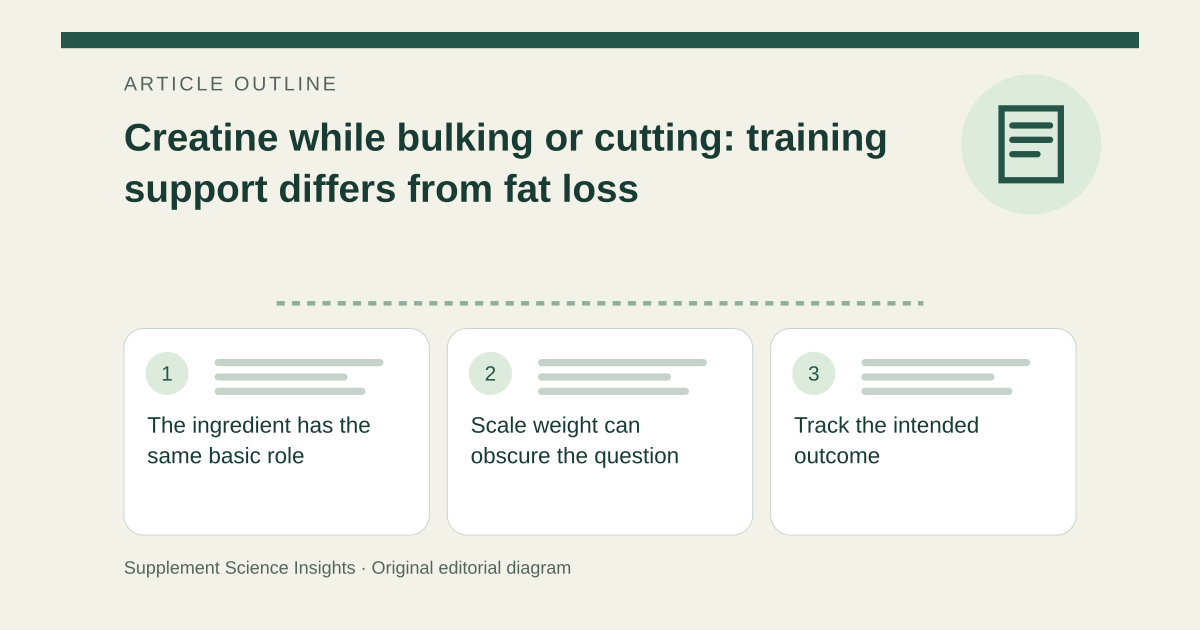
The ingredient has the same basic role
Creatine supports the phosphocreatine system and is studied for certain high-intensity exercise tasks. A person’s calorie goal does not turn it into a different molecule. Whether it is useful depends on the exercise demands and individual context, not simply the name assigned to a training phase. [1]
Scale weight can obscure the question
Creatine use can increase body weight through water-related changes, particularly early in use. That is not automatically fat gain, but it can complicate short-term scale interpretation during a planned weight reduction. Neither water gain nor a lean-mass measurement should be treated as a direct measure of new contractile muscle. [2][1]
Track the intended outcome
Imagine a person reducing calorie intake sees a higher scale reading after starting creatine. That observation alone does not prove the food plan failed or that creatine burned or added body fat. Assess trends, performance and the broader plan rather than using one day’s weight to decide whether creatine belongs only in a bulking phase. [1][2]
| Example | Meaning |
|---|---|
| Training performance | One relevant creatine outcome |
| Early scale increase | May include water |
| Fat-loss goal | Not a direct creatine claim |
Sources for this article
- Dietary Supplements for Exercise and Athletic Performance - Health Professional Fact Sheet
Source consulted: 2026-09-20. This is a reference resource, not a claim that we conducted the studies or tested a product. - Common questions and misconceptions about creatine supplementation: what does the scientific evidence really show? | Journal of the International Society of Sports Nutrition | Springer Nature Link
Source consulted: 2026-09-20. This is a reference resource, not a claim that we conducted the studies or tested a product.