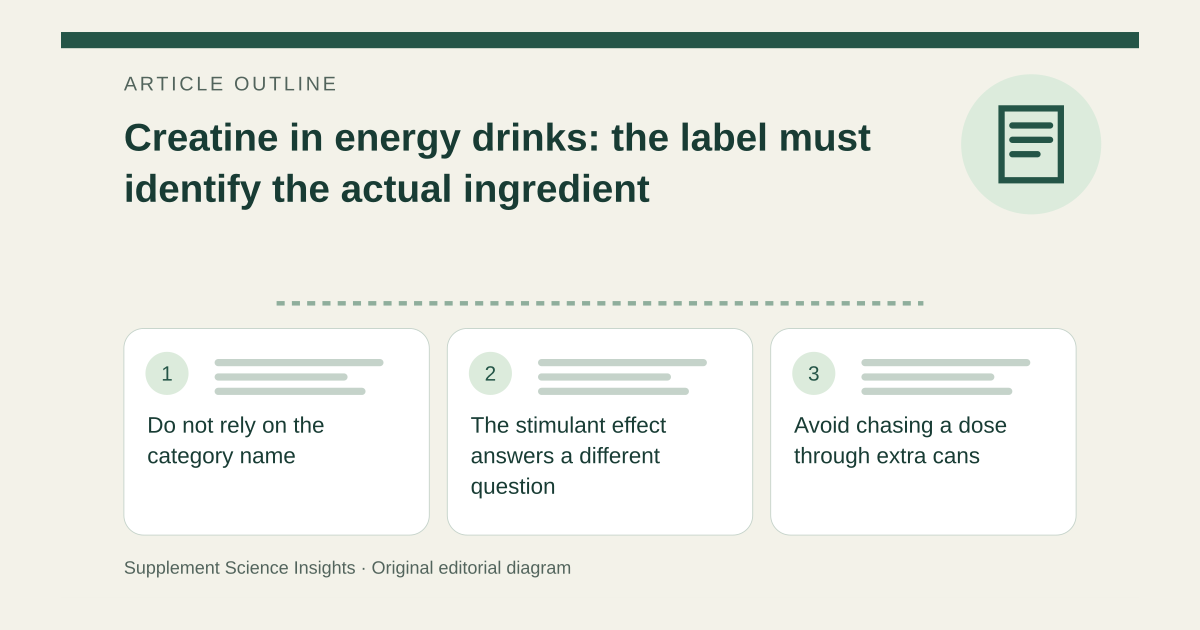
Do not rely on the category name
Energy-drink marketing can refer to caffeine, vitamins or other ingredients without supplying creatine. If creatine is claimed, check its exact name and declared amount per container. A similarly named proprietary compound should not automatically be treated as the creatine monohydrate used in most performance research. [1][2]
The stimulant effect answers a different question
A quick feeling of alertness does not show that creatine stores have increased. Creatine’s research context concerns repeated intake and particular exercise tasks rather than the immediate sensation of an energy drink. Caffeine and other ingredients need their own assessment even when creatine is also present. [1]
Avoid chasing a dose through extra cans
Imagine a drink does not disclose a usable creatine amount. Consuming more cans cannot solve that uncertainty and increases other ingredients. If a drink does disclose creatine, count it with any separate supplement. This is a label framework, not a claim about a current brand’s formula or a recommendation to use energy drinks. [2][1]
| Example | Meaning |
|---|---|
| Energy label | Does not establish creatine content |
| Proprietary ingredient name | Not automatic monohydrate equivalence |
| Extra cans | Increase the complete formula |
Sources for this article
- Dietary Supplements for Exercise and Athletic Performance - Health Professional Fact Sheet
Source consulted: 2026-09-20. This is a reference resource, not a claim that we conducted the studies or tested a product. - Questions and Answers on Dietary Supplements | FDA
Source consulted: 2026-09-20. This is a reference resource, not a claim that we conducted the studies or tested a product.