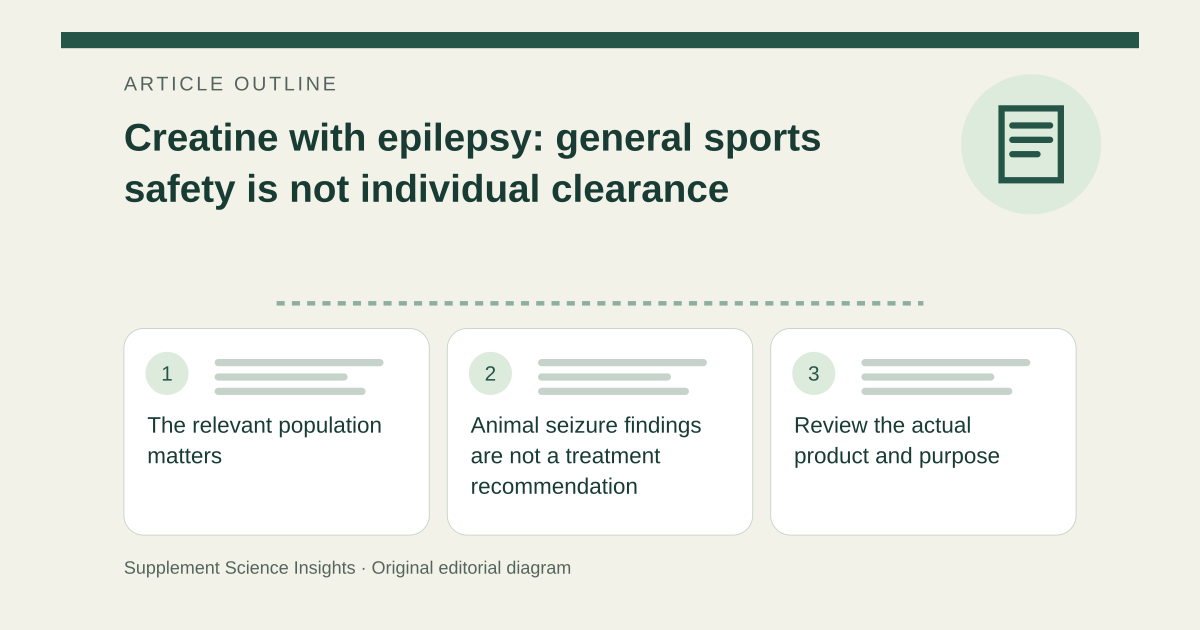
The relevant population matters
NIH summarizes creatine use for exercise, particularly in healthy athletes. That is not the same as a study showing safety across epilepsy syndromes, anti-seizure medicines and different levels of seizure control. Neither automatic prohibition nor automatic clearance follows from the sports evidence alone. [1][2]
Animal seizure findings are not a treatment recommendation
A women’s-health review discusses creatine in fetal animal models exposed to hypoxia. Those experiments differ from an adult or child living with epilepsy and taking medicines. They cannot establish that a sports supplement prevents that person’s seizures. The review had industry-supported publication costs and disclosed advisory roles. [3]
Review the actual product and purpose
Bring the ingredient list, serving amount, medicines and seizure history to the treating team. A stimulant-containing pre-workout is not equivalent to plain creatine. Consider effects on sleep and tolerance rather than assuming all products with the same headline ingredient have the same risk. [1][4][2]
Keep the seizure plan in place
NHS advises against changing or stopping anti-seizure medicines without specialist advice. Use the individual emergency plan. A first seizure, a seizure lasting longer than usual or over five minutes when the usual duration is unknown, or failure to recover normally needs emergency help. [2]
Do not use a supplement experiment to test seizure control
Imagine someone with controlled epilepsy wants to add a caffeinated creatine blend and reduce prescribed medicine. These are separate decisions for the epilepsy team; a training goal is not evidence that treatment can be withdrawn. [2][1]
| Information | Why provide it? |
|---|---|
| Seizure type and recent pattern | Individual risk context |
| Medicines | Review the complete regimen |
| Full product label | Distinguish creatine from a stimulant blend |
| Emergency plan | Remains necessary |
Sources for this article
- Dietary Supplements for Exercise and Athletic Performance - Health Professional Fact Sheet
Source consulted: 2026-09-21. This is a reference resource, not a claim that we conducted the studies or tested a product. - Epilepsy - NHS
Source consulted: 2026-09-21. This is a reference resource, not a claim that we conducted the studies or tested a product. - Creatine in women’s health: bridging the gap from menstruation through pregnancy to menopause - PMC
Source consulted: 2026-09-21. This is a reference resource, not a claim that we conducted the studies or tested a product. - Spilling the Beans: How Much Caffeine is Too Much? | FDA
Source consulted: 2026-09-21. This is a reference resource, not a claim that we conducted the studies or tested a product.