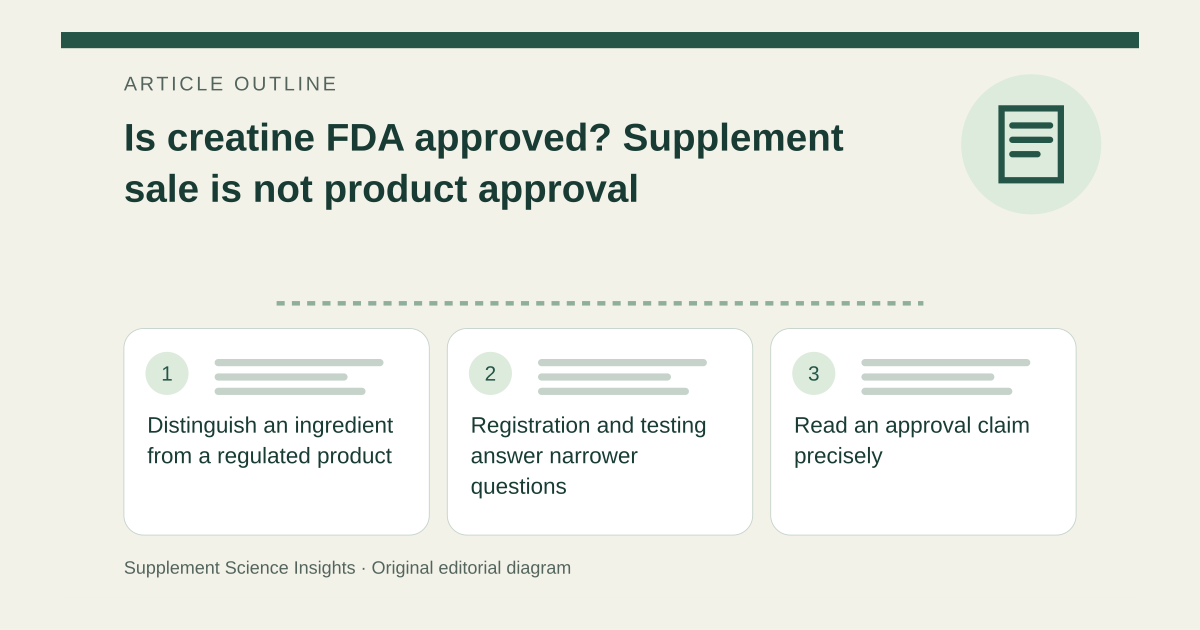
Distinguish an ingredient from a regulated product
A creatine supplement is assessed under the dietary-supplement framework, not assumed to be an approved medicine. FDA describes manufacturers as responsible for safety and truthful labeling. The absence of premarket product approval does not mean there are no manufacturing or labeling requirements. [1]
Registration and testing answer narrower questions
A facility registration, manufacturing statement or private quality test is not FDA endorsement of a finished supplement. A quality assessment may address identity, amounts or contamination within its stated scope. That still differs from demonstrating the product’s clinical or sports-performance effect. [1][2]
Read an approval claim precisely
Imagine a seller says its creatine is made in an FDA-registered facility. That wording does not establish FDA approval of the powder. Review the actual formula and quality evidence, then assess whether the ingredient’s exercise evidence fits the intended use. Neither a regulatory slogan nor a supplement category alone resolves those questions. [1][3]
| Example | Meaning |
|---|---|
| Available for sale | Not premarket product approval |
| Registered facility | Not an approved benefit claim |
| Independent quality testing | Only its stated testing scope |
Sources for this article
- Questions and Answers on Dietary Supplements | FDA
Source consulted: 2026-09-20. This is a reference resource, not a claim that we conducted the studies or tested a product. - Dietary Supplements: What You Need to Know
Source consulted: 2026-09-20. This is a reference resource, not a claim that we conducted the studies or tested a product. - Dietary Supplements for Exercise and Athletic Performance - Health Professional Fact Sheet
Source consulted: 2026-09-20. This is a reference resource, not a claim that we conducted the studies or tested a product.