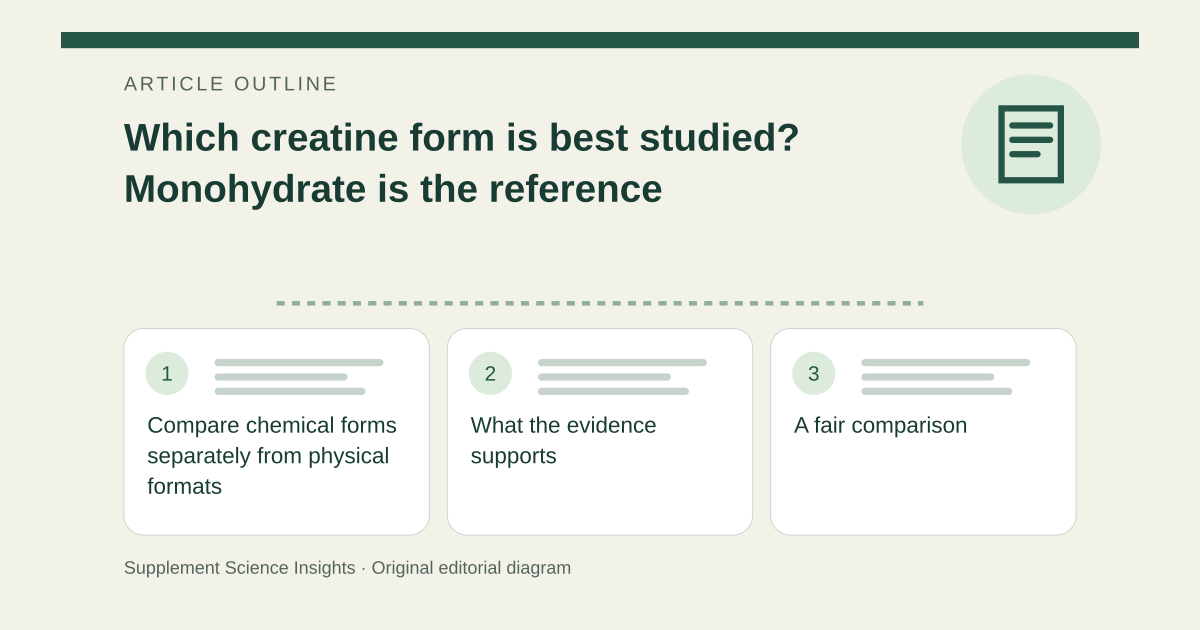
Compare chemical forms separately from physical formats
Monohydrate, salts and other derivatives describe different ingredients. Capsules, powders and gummies describe how a product is delivered. Micronized monohydrate remains monohydrate with a different particle-size preparation; a physical format is not automatically a new active molecule. [1]
What the evidence supports
NIH ODS identifies monohydrate as the most widely studied form and notes that several marketed alternatives have not demonstrated superior effectiveness or safety. This is not an exhaustive ranking of every current product. A claim about solubility, taste or convenience also does not automatically demonstrate improved muscle performance. [1]
A fair comparison
Imagine two powders advertise equal scoop weights, but one contains monohydrate and the other a blend with several ingredients. Compare the declared creatine ingredient and amount rather than assuming the full scoop is equivalent. Consider quality documentation and the intended use; no retail brand has been independently tested or ranked in this article. [1]
| Hypothetical label term | Category |
|---|---|
| Monohydrate | Chemical form |
| Capsule or gummy | Delivery format |
| Micronized monohydrate | Particle-size preparation of monohydrate |
Which forms have actually been compared in human trials?
In a seven-week trial, 30 men without resistance-training experience were assigned creatine monohydrate, creatine ethyl ester or placebo alongside training. Loading and maintenance amounts were based on fat-free mass. Ethyl ester did not produce superior strength, power or body-composition outcomes; the measured muscle-creatine results did not show a significant difference between the two creatine groups. Higher serum creatinine in the ester group was a separate finding, not a diagnosis of kidney injury. [2][3]
A second trial randomized 36 resistance-trained participants to standard monohydrate, buffered creatine at 1.5 g/day, or buffered creatine using the same loading and maintenance amounts as monohydrate for 28 days. It did not find superior training outcomes or fewer reported side effects with the buffered product. Muscle-biopsy data were available for a smaller subgroup, and the study was short. [2][3]
These are concrete comparisons of ethyl ester and buffered preparations with monohydrate, not a completed ranking of every salt, gummy or branded raw material. They also do not establish that all amounts or finished products are equivalent. Use the actual comparison and endpoint rather than assuming better solubility proves better performance. [2][3]
Sources for this article
- Dietary Supplements for Exercise and Athletic Performance - Health Professional Fact Sheet
Source consulted: 2026-09-20. This is a reference resource, not a claim that we conducted the studies or tested a product. - Spillane et al. — Creatine ethyl ester, resistance training and muscle creatine
Source consulted: 2026-10-28. This is a reference resource, not a claim that we conducted the studies or tested a product. - Jagim et al. — Buffered creatine compared with creatine monohydrate
Source consulted: 2026-10-28. This is a reference resource, not a claim that we conducted the studies or tested a product.