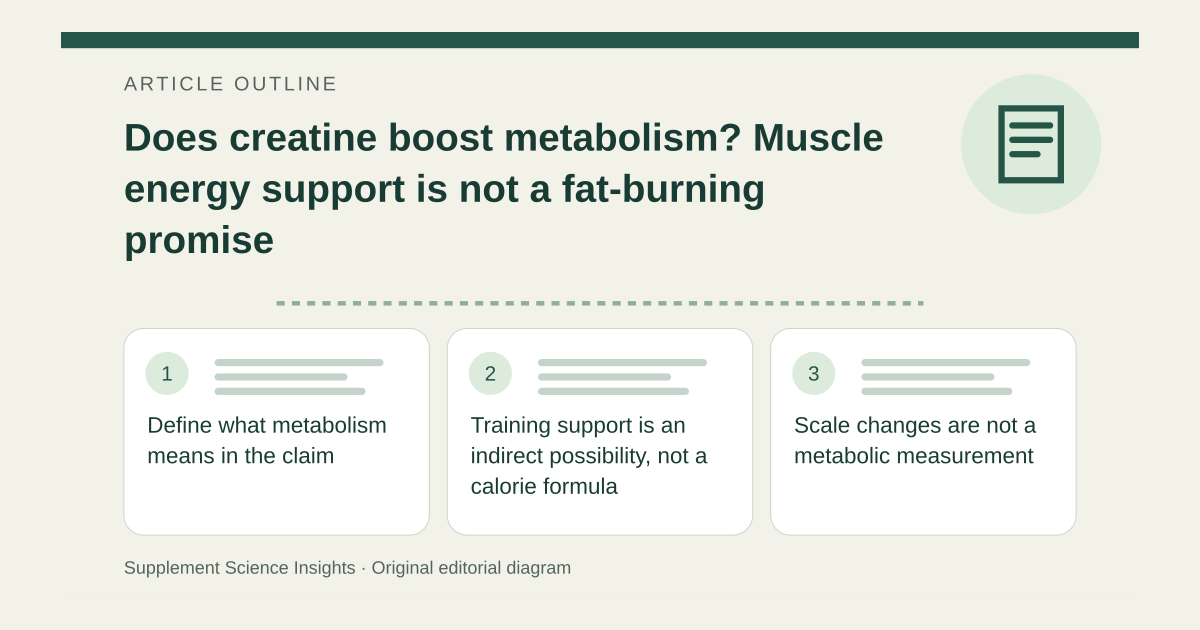
Define what metabolism means in the claim
NIH describes creatine’s role in supplying energy during short, intense efforts. Helping recycle energy during a task is different from proving that the whole body burns a clinically meaningful number of extra calories each day. The word energy can refer to both, but the evidence cannot be swapped between them. [1]
Training support is an indirect possibility, not a calorie formula
Creatine can support repeated high-intensity exercise and training adaptations. If training improves, that does not provide a reliable equation for extra daily calories burned because of the supplement. The inspected sources do not establish a universal resting-metabolism increase. [1]
Scale changes are not a metabolic measurement
Creatine can increase body weight, including water-related changes. A higher or lower scale reading does not separately identify fat, muscle and water, and it does not measure resting energy expenditure. The 2021 review discusses these distinctions and discloses industry relationships. [1][2]
Keep weight management grounded in the full plan
NIDDK emphasizes sustainable eating, activity and support in weight-management programmes. Creatine is not a replacement for those elements or evidence of targeted fat loss. Taking extra powder to force a faster metabolism is not supported by the sources inspected here. [3][1]
Ask for the actual measurement
Imagine an advertisement promises a metabolism boost but cites only greater repetitions in a strength exercise. That finding can be relevant to training; it does not demonstrate higher resting calorie expenditure or fat loss. [1]
| Outcome | What it means |
|---|---|
| Repeated intense efforts | Exercise performance |
| Resting energy expenditure | Separate measurement |
| Scale weight | Mix of tissues and water |
| Fat loss | Not established by an energy-system mechanism |
Sources for this article
- Dietary Supplements for Exercise and Athletic Performance - Health Professional Fact Sheet
Source consulted: 2026-09-21. This is a reference resource, not a claim that we conducted the studies or tested a product. - Common questions and misconceptions about creatine supplementation: what does the scientific evidence really show? | Journal of the International Society of Sports Nutrition | Springer Nature Link
Source consulted: 2026-09-21. This is a reference resource, not a claim that we conducted the studies or tested a product. - Choosing a Safe & Successful Weight-loss Program - NIDDK
Source consulted: 2026-09-21. This is a reference resource, not a claim that we conducted the studies or tested a product.