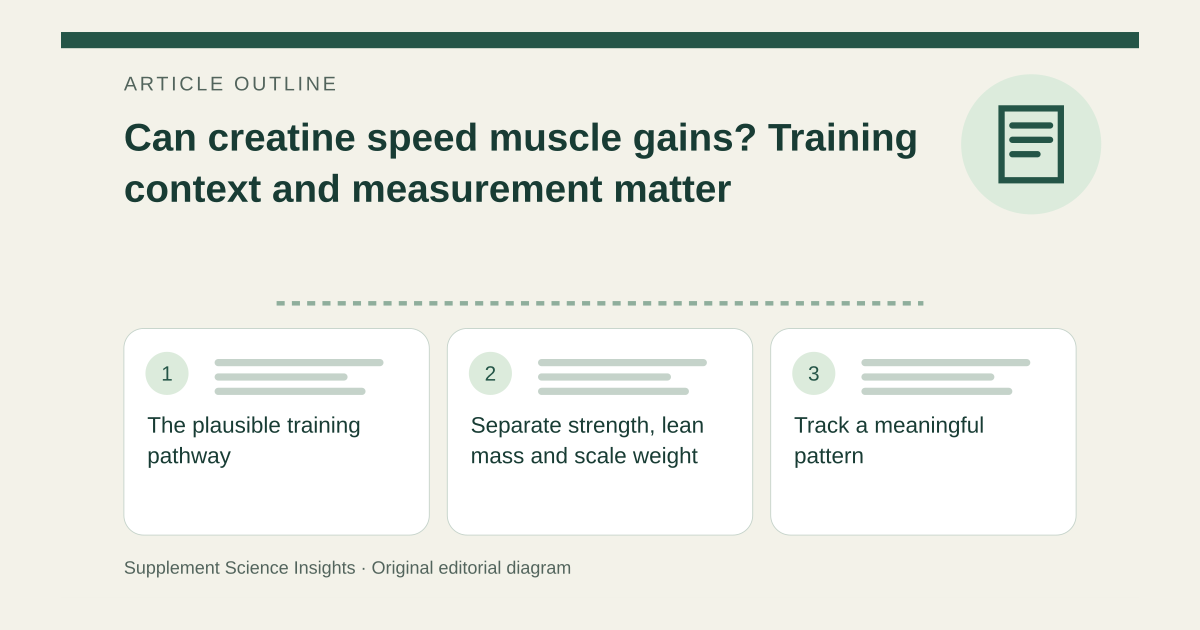
The plausible training pathway
NIH ODS describes creatine’s support for repeated high-intensity efforts and structured training. Being able to perform more work can support adaptation over time, but the result depends on the training program, nutrition and individual response. Creatine does not replace the exercise stimulus or adequate protein. [1]
Separate strength, lean mass and scale weight
These are related but different measurements. Creatine-associated water changes can affect body weight and some lean-mass estimates, especially early in use. A scale change alone cannot show how much contractile tissue was added, and the same kilogram change should not be promised to every user. [1]
Track a meaningful pattern
Imagine a lifter records stable exercise technique, loads, repetitions and body weight across several weeks. Improved repetitions may be relevant to performance; one heavier morning does not prove faster muscle growth. Compare the overall pattern and avoid changing multiple supplements and the entire training plan at once if trying to understand the response. [1]
| Hypothetical measurement | What it shows |
|---|---|
| More repetitions at a fixed load | Performance change |
| One higher body-weight reading | Not a muscle-specific measurement |
| Longer-term training progress | Context for evaluating usefulness |
Sources for this article
- Dietary Supplements for Exercise and Athletic Performance - Health Professional Fact Sheet
Source consulted: 2026-09-20. This is a reference resource, not a claim that we conducted the studies or tested a product.