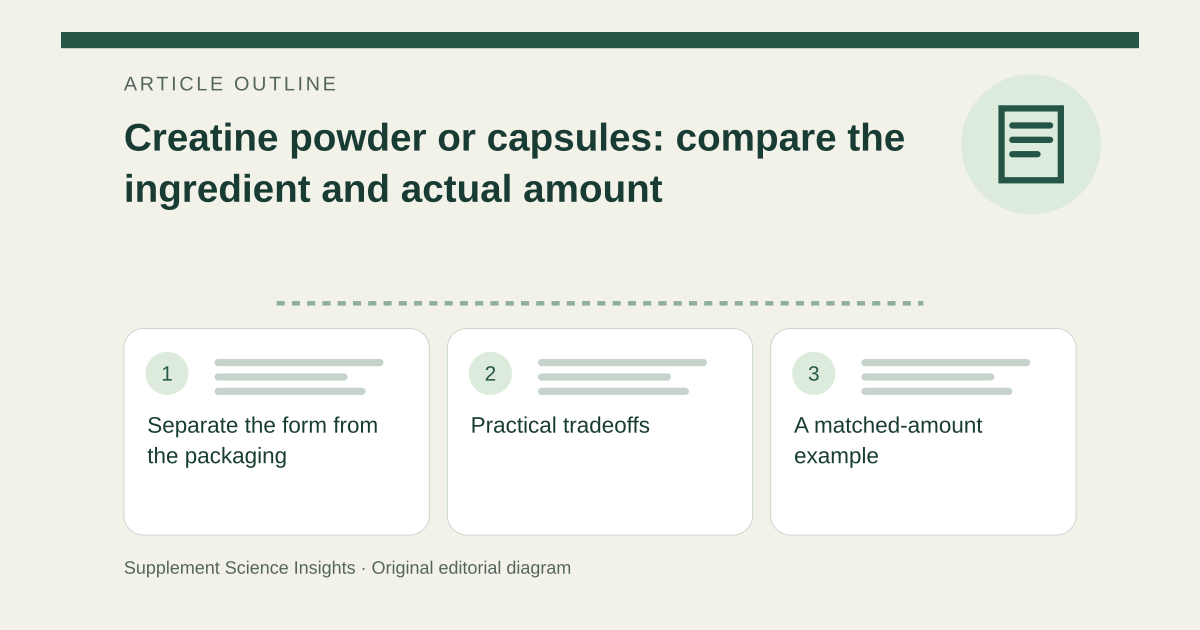
Separate the form from the packaging
Creatine supports the rapid energy system used in short, intense activity. The research summarized by NIH ODS centers heavily on creatine monohydrate. Powder versus capsule is a packaging distinction; monohydrate versus another chemical form is an ingredient distinction. Do not assume a pill is a different or stronger active ingredient. [1]
Practical tradeoffs
Powder requires measuring and mixing. Capsules avoid mixing but may require several units to provide the label’s serving, and swallowing convenience varies. Compare the full ingredients, declared creatine amount and price per equivalent amount. Neither format replaces training, and an attractive capsule count does not establish the amount per capsule. [1]
A matched-amount example
Imagine a powder serving declares 3 g creatine monohydrate and a capsule declares 750 mg of the same ingredient. Four capsules total 3,000 mg, or 3 g. This shows how to compare labels, not that this is the right dose for every person or that the products have been independently tested. Compare like chemical forms before doing the arithmetic. [1]
| Hypothetical format | Declared amount |
|---|---|
| One powder serving | 3 g creatine monohydrate |
| One capsule | 750 mg creatine monohydrate |
| Four capsules | 3,000 mg = 3 g |
Sources for this article
- Dietary Supplements for Exercise and Athletic Performance - Health Professional Fact Sheet
Source consulted: 2026-09-20. This is a reference resource, not a claim that we conducted the studies or tested a product.