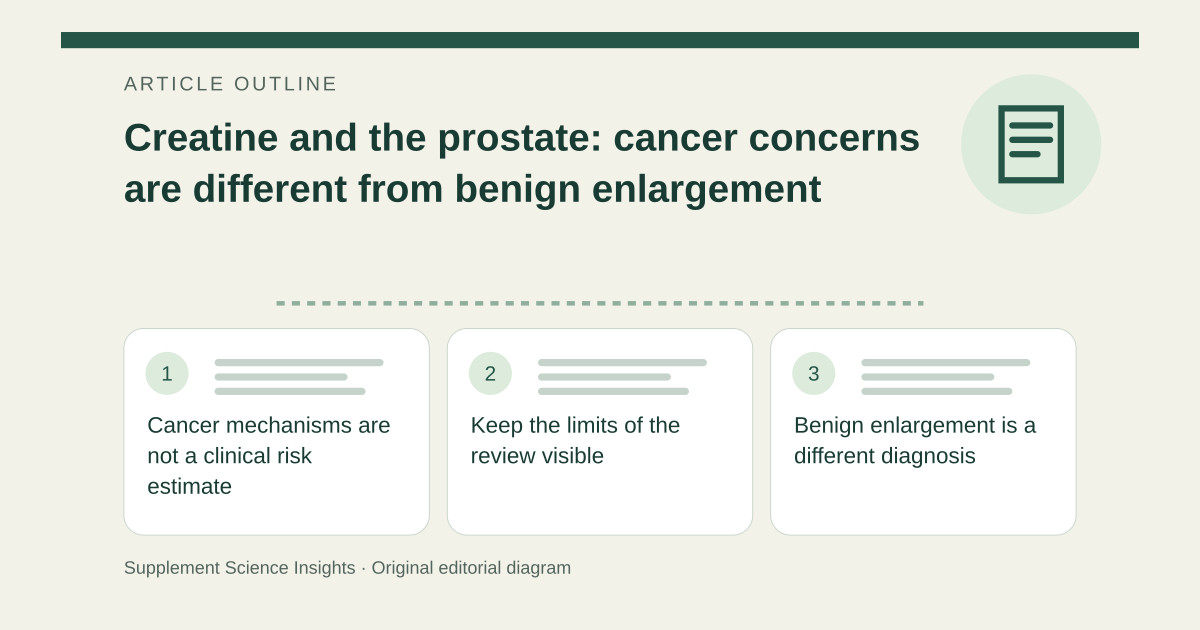
Cancer mechanisms are not a clinical risk estimate
A 2025 narrative review discusses creatine metabolism in cancer cells, animal studies and concerns about compounds formed during meat processing. These are different exposures and models. They do not demonstrate that ordinary creatine supplementation causes prostate cancer in people. Nor do they prove prevention or complete safety for someone who has cancer. [1]
Keep the limits of the review visible
The review argues that available human evidence does not support a general cancer-causing claim at typical supplemental intakes. That conclusion is not equivalent to a large, long-term trial designed to measure prostate-cancer incidence. Several authors disclosed creatine-industry relationships; the review reported no funding for the work. [1]
Benign enlargement is a different diagnosis
NIDDK describes benign prostatic hyperplasia as noncancerous enlargement. It may cause a weak stream, difficulty starting or urinary frequency, but symptoms can have other explanations. The inspected sources do not establish creatine as a usual cause of BPH, and frequent urination after changing fluid intake does not diagnose an enlarged prostate. [2][1]
Do not treat prostate symptoms with a sports supplement
BPH management depends on severity and context and may include monitoring, medicines or procedures. Someone with diagnosed prostate disease or cancer should review supplements with the treating team. A reassuring general sports-safety statement cannot answer every treatment interaction or individual risk. [2][3]
Recognize urinary warning signs
Seek urgent care for inability to urinate, blood in urine, or painful urinary symptoms with fever or chills. These should not be managed by simply stopping or changing a powder and waiting. [2]
Use the symptom, not the assumption
Imagine urinary frequency begins after a new training drink and the person assumes it means prostate cancer. Record the drink and timing, but obtain appropriate assessment for persistent or concerning symptoms. The symptom alone identifies neither cancer nor a creatine effect. [2]
| Question | Necessary distinction |
|---|---|
| Cancer or BPH? | Different conditions |
| Cell or animal experiment? | Not a human incidence estimate |
| More frequent urination? | Not a diagnosis by itself |
| Unable to urinate? | Urgent assessment |
Sources for this article
- Part II. Common questions and misconceptions about creatine supplementation: what does the scientific evidence really show? - PMC
Source consulted: 2026-09-21. This is a reference resource, not a claim that we conducted the studies or tested a product. - Enlarged Prostate (Benign Prostatic Hyperplasia) - NIDDK
Source consulted: 2026-09-21. This is a reference resource, not a claim that we conducted the studies or tested a product. - Dietary Supplements for Exercise and Athletic Performance - Health Professional Fact Sheet
Source consulted: 2026-09-21. This is a reference resource, not a claim that we conducted the studies or tested a product.