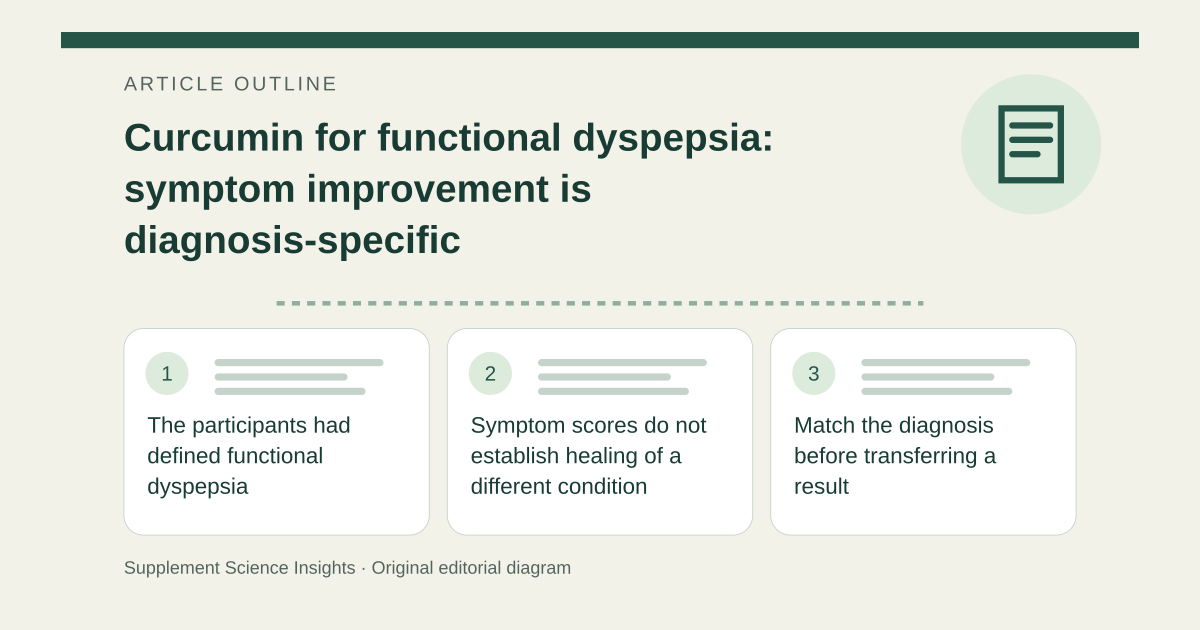
The participants had defined functional dyspepsia
The trial assigned 132 patients meeting Rome IV functional-dyspepsia criteria to curcumin, omeprazole or placebo. After four weeks, pain and non-pain symptom scores improved more with curcumin than placebo. [1]
The curcumin and omeprazole groups did not differ significantly on these symptom comparisons. A nonsignificant difference alone does not prove that two treatments are interchangeable. [1]
Symptom scores do not establish healing of a different condition
The study does not demonstrate treatment of reflux, stomach ulcers, infection or unexplained abdominal pain. The reported quality-of-life comparison did not reach conventional statistical significance. [1]
Four weeks provides limited information about sustained benefit or uncommon harms. Funding and conflicts were not established from the abstract. The tested preparation should not be treated as equivalent to turmeric tea or an arbitrary retail capsule, and this trial is not a reason to discontinue prescribed acid-suppression treatment. [1]
Match the diagnosis before transferring a result
Imagine a study enrolls people with functional dyspepsia. Applying its result to an ulcer caused by infection would change both the condition and the treatment question.
| Detail | Interpretation |
|---|---|
| Functional dyspepsia | Studied diagnosis |
| Four-week symptom scores | Measured benefit |
| Other stomach disorders | Not established |
Sources for this article
- Curcuma longa Linn versus omeprazole in treatment of functional dyspepsia: A randomized, double-blind, placebo-controlled trial - PubMed
Source consulted: 2026-09-19. This is a reference resource, not a claim that we conducted the studies or tested a product.