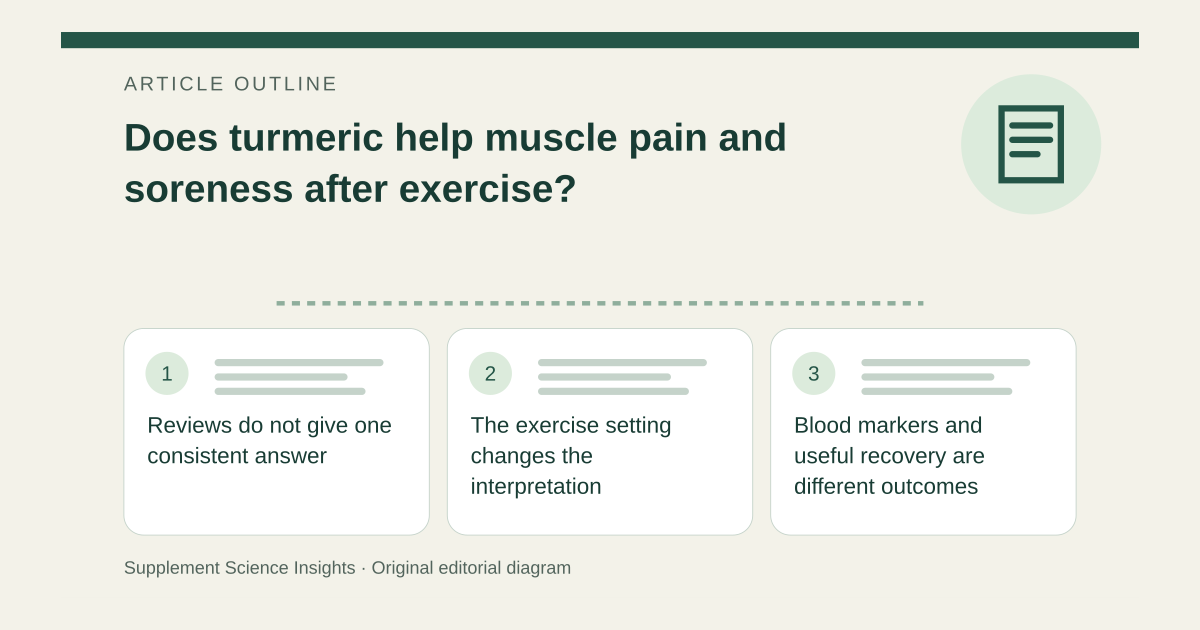
Reviews do not give one consistent answer
A meta-analysis of sixteen papers found no statistically significant pooled effects for soreness, muscle-damage markers or inflammation at its assessed time points. A 2026 review focused on real-world exercise contexts also found inconsistent soreness and performance effects, with very low certainty for most recovery outcomes. [1][2]
The exercise setting changes the interpretation
The 2026 review excluded artificial muscle-damage protocols and clinical populations. Its findings therefore address a different question from a laboratory exercise experiment designed to create soreness. Training status, workload, timing and formulation varied across studies, limiting a universal recommendation. [2]
Blood markers and useful recovery are different outcomes
A change in oxidative-stress markers or creatine kinase does not by itself establish less pain, restored strength or better next-session performance. The latest review rated oxidative-stress evidence somewhat more favorably than subjective recovery, but still with low certainty. [2]
There is no dependable all-purpose recovery dose
Powder, curcumin extracts and enhanced formulations differ. The reviews do not establish a single dose for every athlete or workout. NCCIH also reports gastrointestinal effects and liver injury with some enhanced products, so chasing maximum absorption can introduce risks. [2][3]
Track what matters to the training decision
Imagine a supplement lowers a laboratory marker while soreness and strength are unchanged. That result does not justify assuming full recovery or increasing training load. Judge meaningful function and the broader training plan rather than treating the marker as a readiness certificate. [2][1]
| Outcome | Interpretive limit |
|---|---|
| Lower oxidative-stress marker | Not necessarily less soreness |
| Changed creatine kinase | Not proof of restored strength |
| Less soreness in one study | Not a universal dose or effect |
| Different formulation | Requires its own evidence and safety assessment |
Sources for this article
- The effect of curcumin supplementation on functional strength outcomes and markers of exercise-induced muscle damage: A systematic review and meta-analysis - PMC
Source consulted: 2026-09-21. This is a reference resource, not a claim that we conducted the studies or tested a product. - Effects of Curcumin Supplementation on Exercise Recovery, Oxidative Stress, Inflammation, Muscle Damage, and Performance in Exercise and Sport Contexts: A Systematic Review - PMC
Source consulted: 2026-09-21. This is a reference resource, not a claim that we conducted the studies or tested a product. - Turmeric: Usefulness and Safety | NCCIH
Source consulted: 2026-09-21. This is a reference resource, not a claim that we conducted the studies or tested a product.